
Why does my furnace smell like burning, and when is it dangerous?
Burning dust on the first cold night is normal and fades within a few hours. Hot plastic, hot wiring, or rotten eggs isn't. Here's how to tell them apart and what each repair costs.
The short answer
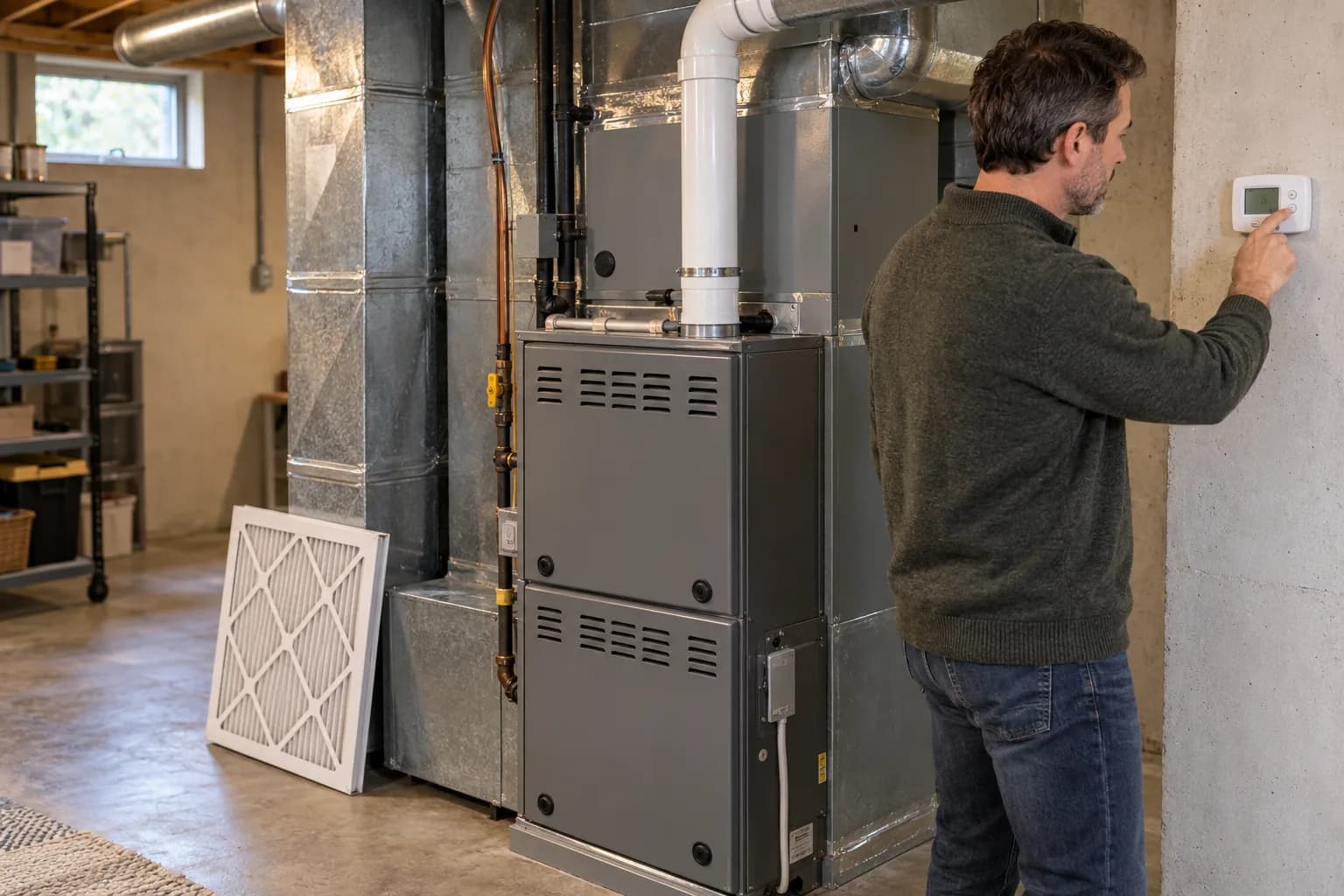
A dusty burning smell the first time you run the heat each fall is usually dust burning off the heat exchanger, and Carrier puts that at 30 minutes to a few hours before it fades. Hot plastic, scorched wiring, or a smell that keeps getting stronger points to an overheating blower motor, a failing electrical part, or something stuck in a vent. Turn the furnace off and call a technician. A rotten-egg smell means gas: leave the house first and call the gas company from outside.
Estimate, not a final quote
This range is for planning. Final pricing depends on an on-site inspection, materials, permits, access, and contractor scope.
Compare written bids
Ask each contractor for the same scope, warranty terms, permit handling, cleanup details, and exclusions before choosing.
Source-backed guidance
Guides use public references and practical cost modeling, then point you to official sources where rules or rebates can change.
This article contains paid links to Amazon. As an Amazon Associate I earn from qualifying purchases.
Carrier gives the first-fire smell a window of 30 minutes to a few hours. Lennox says to let the system run an hour or two. Both describe the same harmless thing: six months of dust burning off the heat exchanger the first time it gets hot. What matters is how long the smell lasts and what it smells like, because the dangerous ones don't fade.
The three-hour clock
Note the time you switched to heat. Trane suggests opening a window before the first startup and starting the season with a clean filter. Then let the furnace run several normal cycles.
The flat rule: a dusty smell that's gone by the end of the afternoon was dust. One that's still there after three hours, gets stronger, or comes back on the next day's cycles isn't. Turn the furnace off at the thermostat and get it looked at. Carrier's line is the same: a smell that lasts more than a few hours or grows stronger is not normal dust burn-off.
There's one exception that also fades. Trane notes that a brand-new furnace can smell like burning dust, plastic, or oil the first time it runs, from residue left on new parts. If your furnace went in this summer, give it the same few hours before you worry.
Name the smell
"Burning" covers several different smells, and each points to a different part. Sniff at a supply register, then at the furnace cabinet. Don't open any panels.
| What you smell | Most likely source | What to do | Published repair cost |
|---|---|---|---|
| Dusty, toasty; first cycles of the season | Dust burning off the heat exchanger | Ventilate, clean filter, wait a few hours | $0 |
| Hot plastic or rubber, worse when the blower runs | Overheating blower motor, often from a clogged filter or dust buildup | Turn off at the thermostat; call a technician | $300–$900 for the motor; $100–$250 for its capacitor |
| Scorched wiring, sharp "electrical" smell | Damaged wire insulation or a failing electrical component | Turn off; call a technician; don't keep resetting the breaker | $300–$650 if it's the control board |
| Burning plastic from one register only | Something fell into the duct or register over the summer | Turn off, check the register opening you can reach | Often $0 if it's reachable |
| Metallic, chemical, or burning smell with soot, headaches, or a CO alarm | Possible cracked heat exchanger | Get everyone out if the alarm sounds; call a technician | Around $1,500, or a new furnace |
| Rotten eggs or sulfur, with or without hissing | Natural gas leak | Leave now; call the gas company from outside | Gas company first, then a repair |
Motor and board figures are Trane's published averages for furnace repairs. The heat exchanger figure is Lennox's. Your local diagnostic fee and labor rate come on top of all of them.
Cost estimator
HVAC cost estimator
A budgeting range, not a quote. Move the inputs to see what changes the number.
Estimated national cost
Typical project lands near $8,250.
If a written quote comes in above the high end, that's not automatically wrong — ask what scope is driving it.
What this assumes
- Standard central HVAC replacement scope.
- 1,500 sq ft home size selected.
- No major duct, electrical, or structural repairs included.
What moves this price
- 01Equipment tier, SEER2 rating, and brand.
- 02Ductwork condition and attic or crawlspace access.
- 03Permit requirements, refrigerant changes, and local labor rates.
Walk into your quotes ready
This range is your anchor. Bring these to every contractor conversation so you can tell a fair quote from a padded one.
- What SEER2 rating and tonnage are you quoting, and why that size for my home?
- Is a full load calculation (Manual J) included, or are you sizing by rule of thumb?
- Does the price include new line sets, a permit, and haul-away of the old unit?
- What's the labor warranty, and is it separate from the manufacturer's parts warranty?
- A quote given over the phone without seeing your ductwork or home.
- Pressure to decide today or 'lose' a discount.
- An oversized system pitched as 'more powerful'. Bigger isn't better for comfort.
Hot plastic: usually the blower, usually the filter
The blower is the fan that moves air through the furnace and out to your rooms. Its motor has to work harder to pull air through a clogged filter, and a motor that works harder runs hotter. Carrier names an overheated blower motor, often caused by heavy dust or a clogged filter, as a common source of a burning-plastic smell. Trane lists an overheating blower motor among the problems that a burning electrical smell can point to.
Your part is the filter. Choose a replacement filter in the size and rating specified by the equipment. If the old one came out gray and bowed, tell the technician; a new filter won't undo weeks of running hot. Everything behind the blower door is the technician's part.
On cost, Trane and Carrier both put blower motor replacement at $300 to $900, and Carrier gives an average of about $560. Labor makes up roughly $150 to $250 of that when the motor isn't under warranty. Variable-speed ECM motors sit at the top of the range, and single-speed PSC motors sit at the bottom. If the motor is fine and the capacitor that starts it is failing, Trane's average is $100 to $250.
Age decides the repair-or-replace question. Trane says a blower motor is built to last about as long as the furnace, 15 to 20 years. On a 10-year-old furnace, a one-time motor replacement is a sensible repair. On a furnace past 15 that has also needed other repairs, Trane's own advice is to start pricing a new furnace.
Scorched wiring: off, and stay off
A sharp electrical smell is different from hot plastic, and the response is stricter. Trane calls a melting-plastic smell from wire insulation a big safety hazard and says to turn the furnace off and call for repair. Lennox and Carrier both say an electrical smell means shut down now, not wait and see.
Turn it off at the thermostat. If a breaker has tripped, leave it tripped. Resetting it again and again is how a small wiring fault turns into a fire. Don't take off the burner or blower doors to look for the source. Behind them are 120-volt wiring, the gas valve, and the igniter, and diagnosing them is a licensed technician's job.
Most of these calls end at a component, not the whole furnace. Trane puts a furnace control board at $300 to $650 and an igniter at $100 to $250. A draft inducer motor, the small fan that pushes exhaust out the flue, costs more at $400 to $1,100. Trane also advises getting a second opinion on any repair quoted above $500.
One register, not the whole house
If the smell comes strongly from one register and barely from the others, the furnace may be fine. Lennox points out that small objects fall into vents over the summer and cook in the fall. Turn the system off, lift the grille, and remove anything you can reach by hand. Anything deeper is a job for a duct cleaner or HVAC technician, not a coat hanger.
When the smell is a safety call, not a repair
Two smells mean people out first, cost later.
Rotten eggs. Natural gas has no smell of its own. Utilities add an odorant called mercaptan so you'll notice a leak. Trane's instructions are specific: don't light anything, don't flip any electrical switch, don't use a phone inside, get everyone and the pets out, and call the gas company once you're away from the house. A hissing sound near the furnace is part of the same warning.
Metallic or chemical, especially with symptoms. Lennox lists a burning, metallic, or chemical smell among the signs of a cracked heat exchanger, along with soot near the burners and unexplained headaches, nausea, or dizziness. The heat exchanger is the wall that keeps combustion gases out of the air you breathe. EPA lists leaking furnaces and back-drafting furnaces as sources of carbon monoxide. It notes CO symptoms are often mistaken for the flu. If the alarm sounds or several people in the house feel ill, get outside first and diagnose later.
If a heat exchanger is confirmed cracked, Lennox puts replacement at around $1,500, and says that on an older system, or one with other damage, replacing the whole furnace is often the better call. Past 15 years old with a cracked heat exchanger, price the replacement. Our HVAC replacement cost guide covers that budget.
Make next fall's first fire boring
EPA recommends having a qualified professional inspect, clean, and tune fuel-burning appliances every year. It also recommends a CO alarm on every level of the house, including the basement, at least 15 feet from fuel-burning appliances, tested monthly. ENERGY STAR's maintenance checklist says the fall tune-up should include checking gas connections, gas pressure, burner combustion, and the heat exchanger, plus tightening electrical connections and measuring voltage and current on motors. Between visits, the filter habit in our $25-a-year filter guide does most of the blower protection for you.
For other shut-it-down symptoms, see 5 signs you need emergency HVAC repair; if the visit turns into a replacement bid, how to read an HVAC quote covers what belongs on the page.
Research sources
- Trane: Help! My Furnace Smells Like Burning: first-startup dust, new-furnace residue, burning-plastic wiring hazard, and shut-off guidance.
- Trane: Is This Normal? HVAC Smells and Sounds, Explained: mercaptan, rotten-egg gas leak instructions, and hissing.
- Trane: Average Furnace Repair Cost: blower motor, capacitor, igniter, inducer motor, and control board averages; blower motor lifespan; and the advice to get a second opinion above $500.
- Carrier: Burning Smell in House? Causes and Solutions for Furnace Odors: 30-minute-to-few-hours dust window, overheating blower motor, and when to investigate.
- Carrier: Furnace Blower Motor Repair & Replacement Guide: $300–$900 range, about $560 average, and $150–$250 labor share.
- Lennox: Does Your Heater Smell Like It's Burning?: one-to-two-hour dust burn-off, foreign objects in vents, and electrical smells.
- Lennox: What to Do If Your Furnace Has a Cracked Heat Exchanger: warning signs, about $1,500 replacement cost, and when full furnace replacement makes more sense.
- EPA: Carbon Monoxide's Impact on Indoor Air Quality: furnaces as CO sources and symptoms.
- EPA: Carbon Monoxide Poisoning: Protect Your Family and Yourself Factsheet: annual inspection of fuel-burning appliances and CO alarm placement.
- ENERGY STAR: Maintenance Checklist: fall heating check-up items.
Compare local quotes
Ready to compare real quotes from HVAC contractor pros?
Use your estimate as a budget anchor, then compare written contractor bids against it before you decide. Free request, no obligation.
Disclosure: this button opens a third-party quote-matching service. If you submit its form, its contact and privacy terms apply, and SaveBricks may earn a referral fee. It never changes the prices you're quoted, and our cost ranges are set independently — see how we estimate.
The cost guide
Get the monthly cost briefing
One useful email a month: project cost ranges, contractor red flags, and practical ways to avoid an inflated quote.
No spam. Unsubscribe any time. Read our privacy policy.
More hvac guides
Heat Pump Covered in Ice? Frost Is Normal, a Block Is Not
A thin layer of frost on a heat pump in winter is the defrost cycle waiting to run. Ice that survives a defrost is a failed part. Here's how to tell the two apart.
Read guide
House Humid With the AC Running? Read the Hygrometer Before You Buy Anything
A cool, clammy house usually points to the fan setting, an oversized AC, or air leaking in. Here's how to tell which one you have and what each fix really costs.
Read guide
Furnace Blowing Cold Air? Measure the Temperature Rise Before You Call
A working gas furnace heats the air 40 to 70 degrees on many models. A kitchen thermometer tells you whether yours is heating at all, heating then quitting, or losing heat in the ducts.
Read guide