
What should actually be on an HVAC quote?
A real HVAC bid itemizes nine things; most homeowners get four. Here's what belongs on the page, what's negotiable, and where a bare number hides a mismatched system.
The short answer
A complete HVAC quote itemizes nine things: the load calculation behind the sizing, both equipment model numbers, the tested SEER2/HSPF2 rating, refrigerant type, electrical work, condensate management, permit, technician certification, and warranty terms in two parts. A single number next to 'central AC system' tells you nothing about what's actually being installed.

Estimate, not a final quote
This range is for planning. Final pricing depends on an on-site inspection, materials, permits, access, and contractor scope.
Compare written bids
Ask each contractor for the same scope, warranty terms, permit handling, cleanup details, and exclusions before choosing.
Source-backed guidance
Guides use public references and practical cost modeling, then point you to official sources where rules or rebates can change.
This article contains paid links to Amazon. As an Amazon Associate I earn from qualifying purchases.
Nine line items separate a real HVAC quote from a guess wearing a price tag. Most bids on kitchen counters right now show four: a tonnage, a brand name, a total, and a signature line. Here's what a contractor competing for the job would actually check first.
The nine lines a complete quote has
- A load calculation, not a guess. Sizing should trace back to an ACCA Manual J calculation that accounts for your square footage, insulation, window area, and orientation — not "same tonnage as what's coming out." The 2021 IECC, adopted in most states, requires Manual J (and Manual S for equipment selection) for new installs. A contractor who sizes by square-footage rule of thumb routinely oversizes, and an oversized AC short-cycles: it cools the air before it removes the humidity, so the house feels clammy at 72°F.
- Both model numbers, matched. The outdoor condenser and the indoor coil or air handler should be listed by full model number, and together they should carry an AHRI Certificate of Product Ratings. That certificate is the only third-party proof the pair performs at its rated efficiency — swap in a cheaper coil and the tested SEER2 number on the brochure no longer applies to your house.
- The tested efficiency rating. Look for an actual SEER2 and, for heat pumps, HSPF2 number — the metrics DOE standardized testing under in 2023 — not just "high efficiency."
- Refrigerant type, stated. New residential AC and heat pump equipment manufactured or imported after January 1, 2025 can no longer use R-410A (global warming potential 2,088); it's been replaced by R-454B (GWP 466) or R-32 (GWP 675), both classified A2L. If your quote doesn't say which one you're getting, ask — installers with old R-410A stock are still allowed to sell through it, and it changes what refrigerant your system needs for the next 15+ years of service.
- Electrical scope. Disconnect, whip, and breaker sizing, and whether your panel has the capacity for a heat pump's compressor draw without an upgrade.
- Condensate management. IRC Section M1411.3 requires a primary condensate drain pitched at least 1/8 inch per foot, minimum 3/4-inch diameter, and a secondary drain pan or float switch anywhere an overflow could damage the structure — attics and closets, mainly. This is a five-minute, low-cost part; a quote that skips it is skipping code compliance, not saving you money.
- Permit, pulled by the contractor. Same rule as any trade: if you're asked to pull it yourself, the contractor is keeping their name off the inspection record.
- Technician certification. Anyone connecting or evacuating refrigerant lines is legally required to hold EPA Section 608 certification under the Clean Air Act — Type II for the high-pressure equipment in a residential split system. Ask for the card. Unlicensed refrigerant handling carries EPA fines up to $45,000 per day for the company, and it's not the kind of corner you want cut in your attic.
- Warranty, in two parts. Manufacturer parts coverage and contractor labor coverage are separate promises. Register the equipment fast: Carrier gives you 90 days to register for the full 10-year parts warranty (versus 5 years unregistered), and Trane gives you 60 days for the same jump. Miss the window and you're on the base coverage for the life of the system.
Cost estimator
HVAC cost estimator
A budgeting range, not a quote. Move the inputs to see what changes the number.
Estimated national cost
Typical project lands near $8,250.
If a written quote comes in above the high end, that's not automatically wrong — ask what scope is driving it.
What this assumes
- Standard central HVAC replacement scope.
- 1,500 sq ft home size selected.
- No major duct, electrical, or structural repairs included.
What moves this price
- 01Equipment tier, SEER2 rating, and brand.
- 02Ductwork condition and attic or crawlspace access.
- 03Permit requirements, refrigerant changes, and local labor rates.
Walk into your quotes ready
This range is your anchor. Bring these to every contractor conversation so you can tell a fair quote from a padded one.
- What SEER2 rating and tonnage are you quoting, and why that size for my home?
- Is a full load calculation (Manual J) included, or are you sizing by rule of thumb?
- Does the price include new line sets, a permit, and haul-away of the old unit?
- What's the labor warranty, and is it separate from the manufacturer's parts warranty?
- A quote given over the phone without seeing your ductwork or home.
- Pressure to decide today or 'lose' a discount.
- An oversized system pitched as 'more powerful'. Bigger isn't better for comfort.
What actually moves on the price
- Efficiency tier is real menu pricing. A baseline SEER2 system and a high-tier variable-speed unit can carry a $2,000–$4,000 gap for the same tonnage; the payback depends on your climate and utility rates, not a flat rule.
- Timing helps in the shoulder seasons — spring and fall, when installers aren't slammed with emergency AC calls, is when bids get more competitive.
- The deposit should be modest, 10–30%, tied to material delivery. A request for half up front before any equipment shows up is a red flag on cash flow, not pricing.
- Labor on the commissioning step is not worth negotiating down. Startup — checking refrigerant charge and airflow against the manufacturer's specification — is the difference between a system that hits its rated SEER2 and one that just has the sticker for it.
Ask whether the filter cabinet is changing and what size and rating it will accept. Price replacement filters against that confirmed specification when comparing ongoing maintenance costs, rather than assuming your existing stock will fit.
Where the padding actually hides
The vague electrical allowance is the most common one: "electrical as needed" with no unit price attached lets a $200 breaker swap become an $800 line item after the fact. The honest version names the part and a price — "40-amp breaker and whip, $180, confirmed after panel inspection." The bundled "complete system" quote is the second: one number for "new AC system" that won't tell you if the coil is even being replaced, only the condenser. And the reverse red flag matters here more than in most trades — a bid dramatically below the others on an identical tonnage and tier usually means a mismatched AHRI pairing, an R-410A unit sold at year-old pricing, or a tech who isn't 608-certified working under the table. All three save the contractor money you never see back.
Two flat rules
No Manual J on the quote means no quote. Compare tonnage and price only after you've confirmed the sizing came from a calculation, not a guess — an oversized system costs more upfront and runs worse for the next fifteen years.
Don't take a contractor's word on the tax credit. The Section 25C Energy Efficient Home Improvement Credit historically covered qualifying heat pumps up to $2,000 and central AC up to $600 — but 2025 legislation changed the federal rules for equipment installed in 2026, and industry reporting says the credit lapsed for installs after December 31, 2025. If a contractor's proposal nets a federal credit against your 2026 install total, don't take that number on faith: confirm the current-year rule yourself on the IRS credit page before you sign anything. State and utility rebates are a separate question and still worth checking; our heat pump incentives guide covers where those stand.
If the system you're replacing is already on R-410A and needs a repair over a few hundred dollars, get the full replacement quote before you approve the fix — R-410A parts are past their manufacturing cutoff, and supply only gets tighter and pricier from here. Our true cost of AC replacement guide has the fuller budget breakdown once you're past the estimate stage, and if your system is throwing warning signs right now rather than sitting for a scheduled quote, start with emergency HVAC signs instead.
Research sources
- ACCA: Manual J Residential Load Calculation
- EPA: Section 608 Technician Certification
- EPA: Frequent Questions on the Phasedown of Hydrofluorocarbons
- ICC Digital Codes: 2021 IRC Section M1411.3, Condensate Disposal
- ENERGY STAR: HVAC Quality Installation
- IRS: Energy Efficient Home Improvement Credit
- Carrier: Home HVAC Warranty Registration & Coverage
- Trane: Trane Warranties Explained
Compare local quotes
Ready to compare real quotes from HVAC contractor pros?
Use your estimate as a budget anchor, then compare written contractor bids against it before you decide. Free request, no obligation.
Disclosure: this button opens a third-party quote-matching service. If you submit its form, its contact and privacy terms apply, and SaveBricks may earn a referral fee. It never changes the prices you're quoted, and our cost ranges are set independently — see how we estimate.
The cost guide
Get the monthly cost briefing
One useful email a month: project cost ranges, contractor red flags, and practical ways to avoid an inflated quote.
No spam. Unsubscribe any time. Read our privacy policy.
More hvac guides
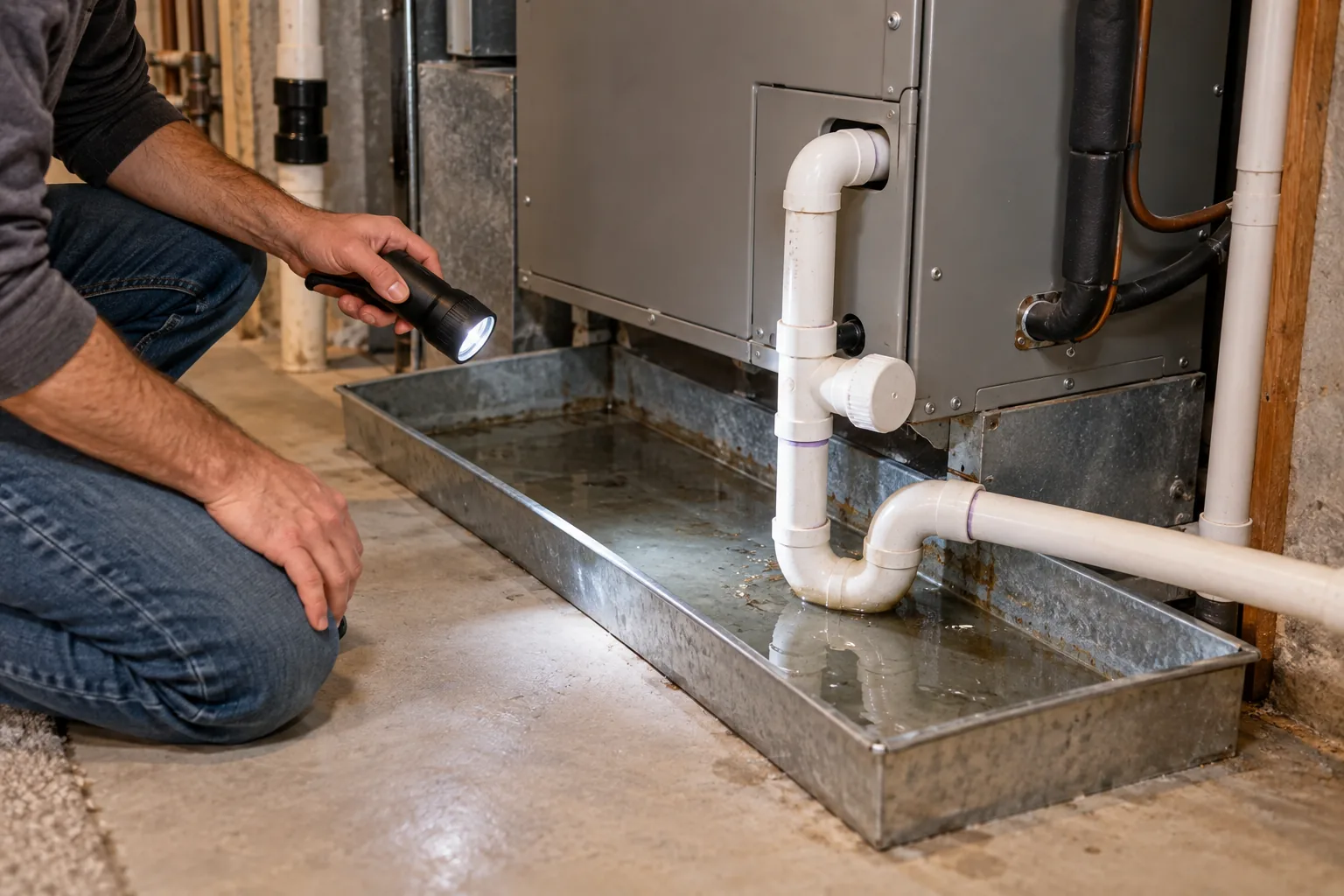
AC Leaking Water Inside? Find Where the Water Stops Moving
Most indoor AC leaks come from a clogged condensate drain, not a broken system. Here's how to tell a drain clog from a cracked pan or an iced coil, and what each costs.
Read guide
The True Cost of AC Replacement in 2026
Rising equipment costs and new refrigerants are reshaping the HVAC market. Here is a practical budget range for a new AC system this year.
Read guide
The Complete Guide to HVAC Replacement Costs
What a combined heating and cooling replacement costs, which line items belong in the bid, and how sizing, ductwork, and efficiency move the total.
Read guide