
Why does my furnace keep turning on and off?
How long your furnace runs before it quits points to the failed part. Here's how to read the timing, what each fix costs, and when the answer is the furnace itself.
The short answer
How long the burners stay lit usually tells you the cause. A flame that drops out within seconds of lighting points to the flame sensor; a furnace that heats for a few minutes, then shuts down while the house is still cold points to overheating and the high-limit switch; a furnace that reaches setpoint fast and does it over and over points to the thermostat or an oversized furnace. Most of these repairs run $80 to $650 at manufacturer-published rates, but a furnace that has short-cycled since the day it was installed is usually oversized, and no part fixes that.
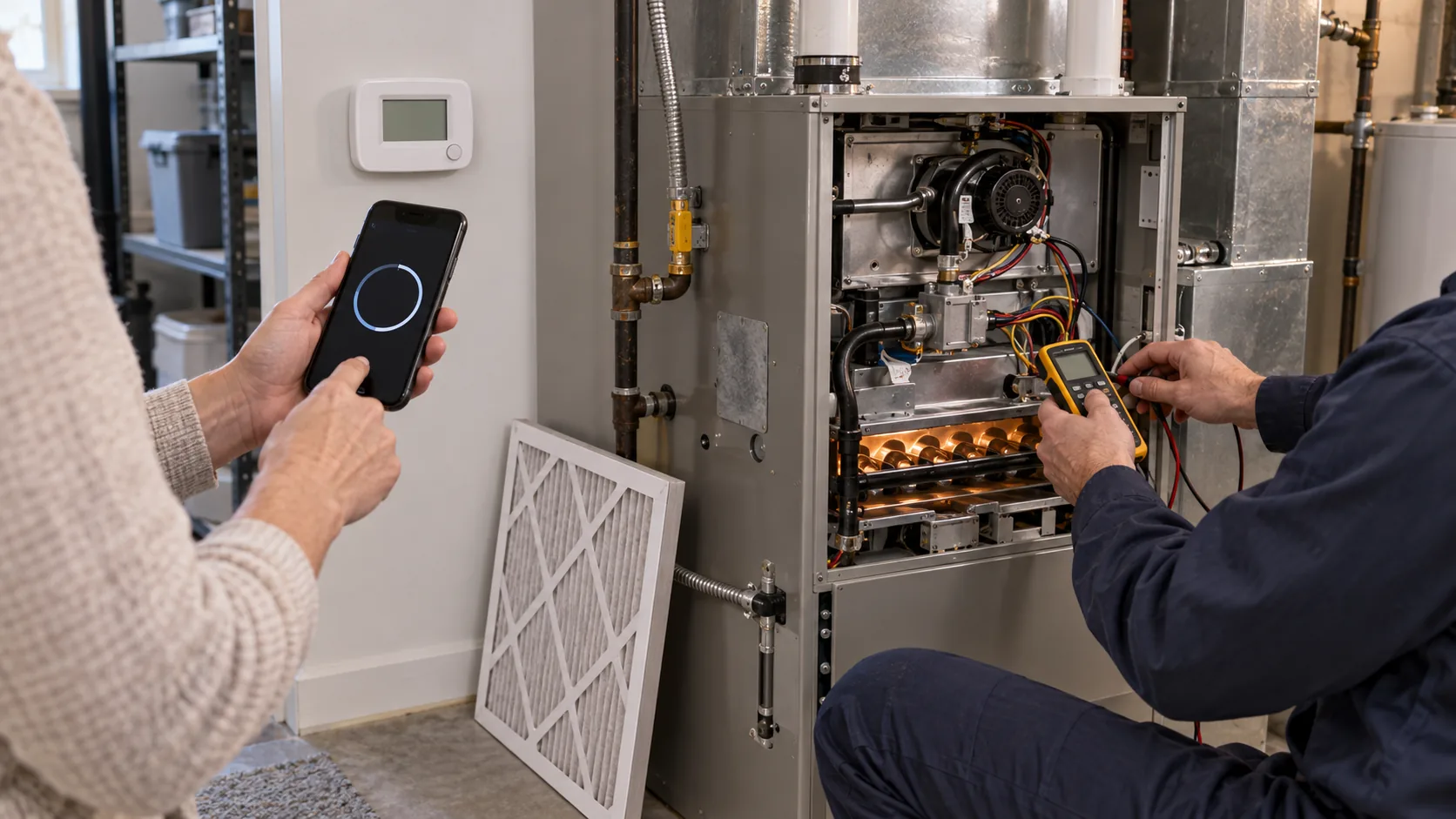
Estimate, not a final quote
This range is for planning. Final pricing depends on an on-site inspection, materials, permits, access, and contractor scope.
Compare written bids
Ask each contractor for the same scope, warranty terms, permit handling, cleanup details, and exclusions before choosing.
Source-backed guidance
Guides use public references and practical cost modeling, then point you to official sources where rules or rebates can change.
This article contains paid links to Amazon. As an Amazon Associate I earn from qualifying purchases.
A mid-efficiency gas furnace is designed to cycle about five times an hour under typical load, and a 90%-plus condensing furnace fewer than that. Honeywell's installer setting for a high-efficiency gas furnace is 3 cycles per hour. If yours is lighting and shutting off every few minutes, something is cutting the cycle short, and the fastest way to narrow it down costs nothing: a phone stopwatch.
Time the burner run first
Stand where you can hear the furnace and watch the thermostat. Start the timer when the burners light (you'll hear the whoosh a few seconds after the inducer fan starts) and note the time when they go out. That's the burner runtime. Check whether the thermostat still says it's calling for heat, then keep the timer going until the burners light again. Ignition to next ignition is one full cycle, and that's the number to compare against five an hour.
The runtime sorts most short-cycling calls into a few patterns, and each one points to a different part.
| What you timed | Most likely cause | Manufacturer-published repair cost |
|---|---|---|
| Burners light, then go out within seconds; furnace retries | Dirty or failed flame sensor | $80–$240 |
| Burners run a few minutes, shut off while the house is still cold | Overheating: clogged filter, blocked returns, or a failing high-limit switch | Filter only, or $100–$375 for the limit switch |
| Inducer runs, burners run briefly or not at all, repeats | Pressure switch, or a blocked flue, vent, or condensate drain | $150–$350 for the switch; less if it's a blockage |
| Full, normal-looking burn, but it reaches setpoint fast, over and over | Thermostat placement or settings, or an oversized furnace | $100–$600 for a thermostat; replacement if oversized |
| Short cycling alongside a metallic smell, rattling, or a CO alarm | Possible cracked heat exchanger | $1,000–$3,000, or replace the furnace |
Costs are Trane's published national estimates; your local labor rate and diagnostic fee sit on top.
Seconds after ignition: the flame sensor
The flame sensor is a thin metal rod sitting in the burner flame. The control board sends a tiny current through the flame and reads it back. If the reading is too weak, the board assumes gas is flowing without a flame and shuts the gas valve within seconds. Trane's installation manual for its current furnace line lists an acceptable flame signal of 0.75 to 3 microamps. A sensor coated in oxidation can fall below that while the flame looks normal.
A technician cleans or replaces the rod, then reads the microamp signal to confirm the fix. Trane says not to do this yourself: the sensor sits in the burner compartment next to the gas valve and ignitor.
If the furnace retries and still can't prove flame, the control board locks out and stops trying. A furnace that short-cycled yesterday and is cold today may simply be locked out. Trane's advice is to have a technician find the cause rather than resetting it again and again.
A few minutes in: the limit switch is doing its job
The high-limit switch watches the temperature in the supply plenum. When the heat exchanger gets too hot, the switch shuts off the gas, and the blower keeps running to cool things down. Trane names short cycling as a main sign of a limit problem, and there are two versions of it.
The common one: the switch is working fine, and something is starving the furnace of airflow. A clogged filter, closed supply registers, or a sofa pushed against the return grille all trap heat in the heat exchanger until it trips. Check those first. If the filter needs replacing, compare replacement filters in the size and rating specified by your equipment. Our filter habit guide explains why this chain gets expensive.
The less common one: the switch itself is failing and tripping below its rated temperature. Replacement runs $100 to $375 by Trane's estimate.
Flat rule: if a technician offers to bypass or jumper the limit switch "to get you through the weekend," say no. It's the part that keeps an overheating heat exchanger from cracking. Trane says outright not to bypass or reset it.
Inducer runs, burners barely do: check the vent
Before the burners light, the inducer fan starts drawing a draft through the heat exchanger so combustion gases will move out the flue. A pressure switch confirms that draft exists before the gas valve is allowed to open. Trane's short-cycling guidance notes that a flue or vent pipe blocked by a bird's nest, a rodent, or debris will shut the furnace down to prevent carbon monoxide from backing into the house.
On a condensing furnace, check the white PVC exhaust pipe where it leaves the house, and the intake pipe beside it on two-pipe installs. Leaves and drifted snow can partly cover them, and a clogged condensate trap can back water up toward the inducer. Clearing snow or leaves from the outside of the pipe is a homeowner job. Taking apart the vent, the trap, or the pressure-switch tubing is not. That's a service call, and so is a pressure switch that fails even with clear pipes, at $150 to $350 by Trane's estimate.
Cost estimator
HVAC cost estimator
A budgeting range, not a quote. Move the inputs to see what changes the number.
Estimated national cost
Typical project lands near $8,250.
If a written quote comes in above the high end, that's not automatically wrong — ask what scope is driving it.
What this assumes
- Standard central HVAC replacement scope.
- 1,500 sq ft home size selected.
- No major duct, electrical, or structural repairs included.
What moves this price
- 01Equipment tier, SEER2 rating, and brand.
- 02Ductwork condition and attic or crawlspace access.
- 03Permit requirements, refrigerant changes, and local labor rates.
Walk into your quotes ready
This range is your anchor. Bring these to every contractor conversation so you can tell a fair quote from a padded one.
- What SEER2 rating and tonnage are you quoting, and why that size for my home?
- Is a full load calculation (Manual J) included, or are you sizing by rule of thumb?
- Does the price include new line sets, a permit, and haul-away of the old unit?
- What's the labor warranty, and is it separate from the manufacturer's parts warranty?
- A quote given over the phone without seeing your ductwork or home.
- Pressure to decide today or 'lose' a discount.
- An oversized system pitched as 'more powerful'. Bigger isn't better for comfort.
Full burns, too many of them: thermostat or sizing
If each cycle looks healthy but there are too many, the burners aren't failing. They're being told to stop.
Start with the thermostat. Trane lists thermostat placement as a short-cycling cause: a thermostat in direct sun, above a supply register, or next to a kitchen gets warm before the rest of the house and ends the call early. A programmable model's cycles-per-hour setting may also be wrong for your equipment; Honeywell says to have your installer adjust it.
If the thermostat checks out, the furnace may simply be too big for the house. Trane calls an oversized furnace the most common cause of short cycling. ACCA's Manual S sizing standard caps furnace output at 140% of the heating load calculated under Manual J. A furnace swapped in at "same BTUs as the old one," or sized off square footage, can easily land past that line.
Flat rule: if it has short-cycled since the day it went in, stop buying parts. No flame sensor or limit switch fixes a furnace that's simply too large, and Trane says the only permanent whole-house fix is a correctly sized replacement. If you're at that point, our HVAC quote guide covers why a Manual J load calculation belongs on the bid, and the HVAC replacement cost guide covers the budget.
When short cycling is a safety problem
Trane lists short cycling as one of the warning signs of a cracked heat exchanger, along with rattling or banging and a sharp metallic smell. The heat exchanger is the wall that keeps combustion gases, including carbon monoxide, out of the air your blower circulates. Those symptoms overlap with ordinary failures, so only a licensed technician can confirm a crack.
If a carbon monoxide alarm sounds, get everyone outside, then call your gas utility or 911. Don't stay in to diagnose it. EPA recommends a CO alarm certified to UL 2034 in the hallway near every separate sleeping area, and treats it as a backup to proper appliance maintenance, not a substitute. Our emergency HVAC signs guide covers the other shut-it-down symptoms.
A confirmed crack is also where the repair math usually flips. Trane's repair guide recommends a second opinion on any furnace repair quoted over $500. A heat exchanger runs $1,000 to $3,000, so it clears that bar easily. On an older, out-of-warranty furnace, that second opinion often ends in a replacement bid.
What to have ready for the technician
Give them your timed cycle, whether the thermostat was still calling for heat, and the LED flash code from the control board. The decoding chart is usually printed on the furnace panel. Codes differ by brand and model, so read yours off your furnace's own chart. A tech who arrives knowing "burners drop out in about five seconds" plus your code starts at the flame sensor instead of billing you for the search. Trane puts an annual furnace tune-up at $70 to about $200. ENERGY STAR's checklist calls for a fall pre-season visit that checks gas pressure, burner combustion, and the heat exchanger, which is where a fouling flame sensor gets caught before January.
Research sources
- Trane: Furnace Short Cycling, Causes and Solutions
- Trane: Furnace Limit Switch, Its Job and Signs of Problems
- Trane: Furnace Main Burner Shuts Off After Ignition
- Trane: Solving Furnace Hard Lock Out Issues
- Trane: Cracked Heat Exchanger, What It Means
- Trane: Furnace Repair Guide for Homeowners
- Trane: Average Furnace Repair Cost
- Trane: Furnace Installation, Operation, and Maintenance Manual (FNR-SVX003A)
- Honeywell Home: My System Turns On and Off Too Fast
- Honeywell Home: What Is a Thermostat Cycle Rate?
- ICC: Reviewing HVAC Designs for Compliance with ACCA Manual S
- ENERGY STAR: Heating and Cooling Maintenance Checklist
- EPA: What About Carbon Monoxide Detectors?
Compare local quotes
Ready to compare real quotes from HVAC contractor pros?
Use your estimate as a budget anchor, then compare written contractor bids against it before you decide. Free request, no obligation.
Disclosure: this button opens a third-party quote-matching service. If you submit its form, its contact and privacy terms apply, and SaveBricks may earn a referral fee. It never changes the prices you're quoted, and our cost ranges are set independently — see how we estimate.
The cost guide
Get the monthly cost briefing
One useful email a month: project cost ranges, contractor red flags, and practical ways to avoid an inflated quote.
No spam. Unsubscribe any time. Read our privacy policy.
More hvac guides
House Humid With the AC Running? Read the Hygrometer Before You Buy Anything
A cool, clammy house usually points to the fan setting, an oversized AC, or air leaking in. Here's how to tell which one you have and what each fix really costs.
Read guide
Heat Pump Covered in Ice? Frost Is Normal, a Block Is Not
A thin layer of frost on a heat pump in winter is the defrost cycle waiting to run. Ice that survives a defrost is a failed part. Here's how to tell the two apart.
Read guide
Why Is Your AC Blowing Warm Air? 7 Causes, Ranked by Cost
Warm air from the vents has one of seven causes, and the most common ones are also the cheapest to fix. Here's how to tell which one you have before a technician tells you.
Read guide