
Why is my air conditioner blowing warm air instead of cold?
Warm air from the vents has one of seven causes, and the most common ones are also the cheapest to fix. Here's how to tell which one you have before a technician tells you.
The short answer
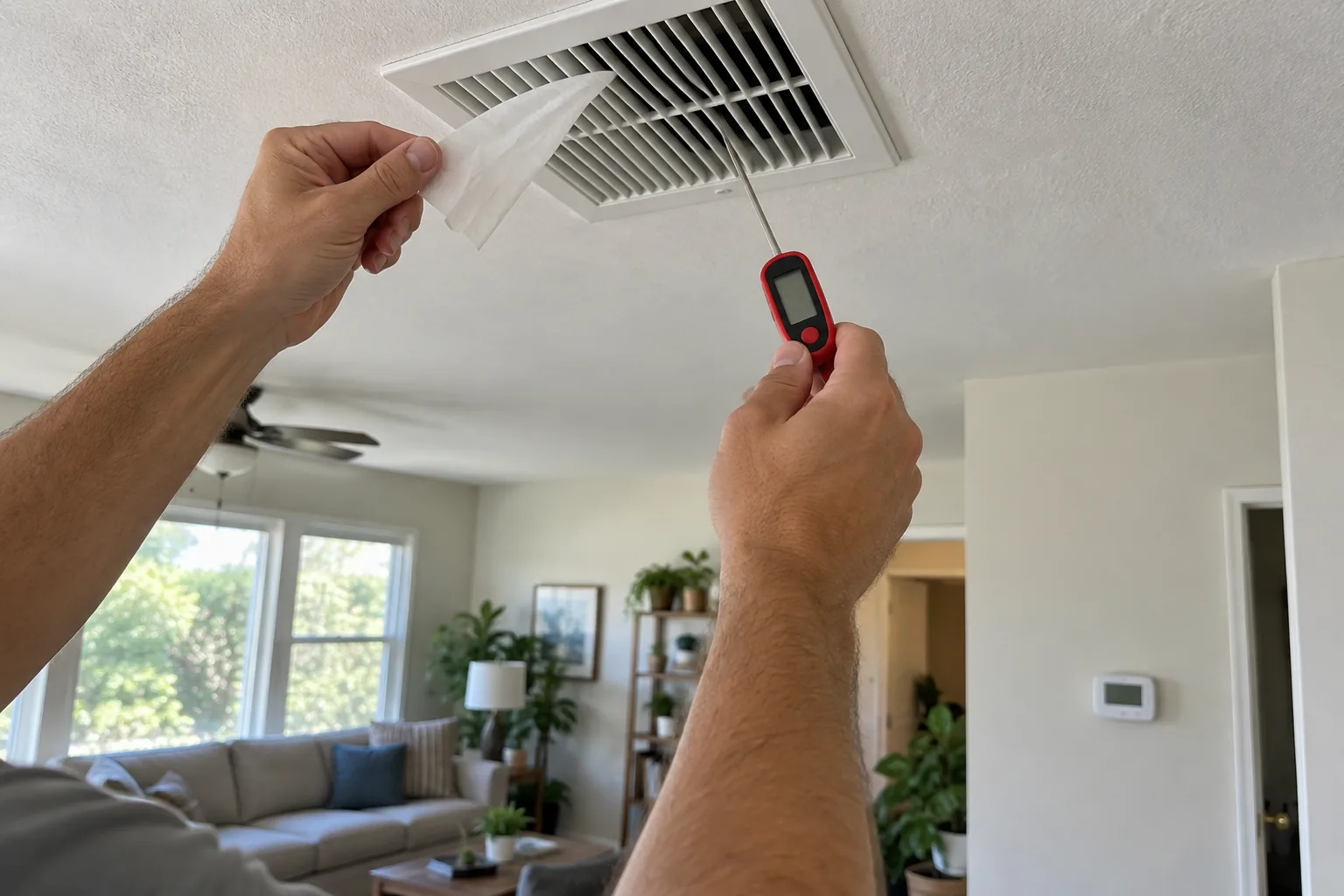
Warm air can come from thermostat settings, airflow restriction, a stopped outdoor unit, coil icing, electrical faults, refrigerant problems, or compressor failure. Several causes feel identical at the vent, so check only the safe basics—mode, setpoint, filter, registers, and visible outdoor obstruction—then get measurements before approving a repair.
Estimate, not a final quote
This range is for planning. Final pricing depends on an on-site inspection, materials, permits, access, and contractor scope.
Compare written bids
Ask each contractor for the same scope, warranty terms, permit handling, cleanup details, and exclusions before choosing.
Source-backed guidance
Guides use public references and practical cost modeling, then point you to official sources where rules or rebates can change.
This article contains paid links to Amazon. As an Amazon Associate I earn from qualifying purchases.
Seven things cause an AC to blow warm air, and two of them are free or under $30 to rule out before you pay anyone a service call fee. Here's the order a technician actually checks them in, and roughly what each one costs once it's confirmed.
The seven causes, ranked
| Cause | How common | Typical repair cost | Check it yourself? |
|---|---|---|---|
| Thermostat set to Fan/Heat, not Cool/Auto | Most common | $0 | Yes |
| Dirty filter → frozen evaporator coil | Very common | $15–$30, plus thaw time | Yes |
| Dirty outdoor condenser coil | Common | $75–$200 | Partly |
| Failed run/start capacitor | Common | $150–$400 | No |
| Tripped breaker or failed contactor | Occasional | $150–$300 | Partly |
| Refrigerant leak (low charge) | Less common | $250–$1,500+ | No |
| Failed compressor | Least common | $1,200–$3,500, or replace the system | No |
Missing lines aren't likely here — this list is close to exhaustive. If a technician names something not on it, ask them to explain the mechanism, not just the part number.
Rule out the two free ones first
Check the thermostat mode before anything else: the fan switch has to read Auto, not On — "On" runs the blower constantly whether or not the compressor is cooling, which feels exactly like warm air blowing from a broken system. Confirm the system mode is Cool, not Heat or Off. It sounds too simple to be real, but a bumped setting or a thermostat that reverted after a power blip is a genuine share of "AC isn't cooling" calls.
Next, pull the filter and hold it up to a light. If you can't see light through it, airflow across the indoor evaporator coil has likely dropped enough to freeze the coil itself — and a frozen coil blocks even more airflow, so warm air keeps coming even though the system is running constantly. ENERGY STAR's home cooling guidance recommends checking filters monthly and replacing them at least every three months during heavy-use season, more often with pets or in dusty climates.
If the coil is a block of ice
Turn the system off and set the fan to On so it can thaw — this takes two to four hours, sometimes overnight. Don't run the compressor against a frozen coil; you risk sending liquid refrigerant back to the compressor, which is a much more expensive problem than the one you started with. Once it's thawed, a fresh filter that fixes the airflow may resolve the problem without a service visit. Match the equipment's specified size and rating, and check current retailer pricing before ordering. If it re-freezes within a day or two of a clean filter and open vents, the cause has shifted from airflow to refrigerant charge — which means a leak, not a filter.
Cost estimator
HVAC cost estimator
A budgeting range, not a quote. Move the inputs to see what changes the number.
Estimated national cost
Typical project lands near $8,250.
If a written quote comes in above the high end, that's not automatically wrong — ask what scope is driving it.
What this assumes
- Standard central HVAC replacement scope.
- 1,500 sq ft home size selected.
- No major duct, electrical, or structural repairs included.
What moves this price
- 01Equipment tier, SEER2 rating, and brand.
- 02Ductwork condition and attic or crawlspace access.
- 03Permit requirements, refrigerant changes, and local labor rates.
Walk into your quotes ready
This range is your anchor. Bring these to every contractor conversation so you can tell a fair quote from a padded one.
- What SEER2 rating and tonnage are you quoting, and why that size for my home?
- Is a full load calculation (Manual J) included, or are you sizing by rule of thumb?
- Does the price include new line sets, a permit, and haul-away of the old unit?
- What's the labor warranty, and is it separate from the manufacturer's parts warranty?
- A quote given over the phone without seeing your ductwork or home.
- Pressure to decide today or 'lose' a discount.
- An oversized system pitched as 'more powerful'. Bigger isn't better for comfort.
The parts that fail without warning
The dual run capacitor is the most common paid repair on this list. It's a cylindrical part about the size of a soda can, rated in microfarads (commonly 35/5, 40/5, or 45/5 µF for a residential condenser and fan motor pair), and it stores the electrical charge that starts the compressor and condenser fan motor. A weak or blown capacitor makes the outdoor unit hum without starting, or start and shut off quickly — which reads at the thermostat as "the AC ran for a minute, then stopped cooling." The part itself costs $15–$45; the $150–$400 total is almost entirely labor and the diagnostic time to confirm it's the capacitor and not the compressor windings behind it.
A tripped breaker or a failed contactor — the relay that switches power to the outdoor unit — shows up the same way: the indoor blower runs, but the outdoor unit never kicks on, so only room-temperature air moves through the vents. Both are cheap fixes once identified; neither is safe to diagnose by opening the disconnect yourself.
The expensive one: a refrigerant leak
A system doesn't consume refrigerant. If the charge is low, it leaked out somewhere — a service valve, a brazed joint, or the evaporator or condenser coil itself — and it will keep leaking until someone finds and seals the point of failure. A technician confirms this with superheat and subcooling readings at the service valves; a reading a few degrees off target with a normal-looking coil is the signature of a slow leak rather than an airflow problem.
Here's the nuance that catches homeowners off guard: residential air conditioning is specifically carved out of the EPA's Section 608 leak-repair requirements that apply to larger commercial refrigeration systems, so nobody is legally required to find your leak before refilling the system. That means "just top it off" is a real offer some technicians will make — and a bad one to accept, because the same amount will leak out again on the same schedule, and you'll have paid for the refrigerant twice. Whoever touches the refrigerant does have to hold EPA Section 608 certification regardless of the leak-repair question; ask to see the card. Expect $250–$1,500 for a found-and-fixed small leak with a recharge, climbing toward $1,200–$4,000 if the leak is inside the coil itself and the coil needs replacing rather than resealing.
When it's the compressor
The compressor is the one component that's expensive enough to change the decision from "repair" to "replace." One flat rule: if the diagnosis lands on a failed compressor and the system is 10 or more years old, replace the outdoor unit rather than swapping the compressor alone. A compressor rarely fails in isolation at that age — the same heat and electrical stress that killed it has usually aged the rest of the unit — and a new compressor is commonly quoted at $1,200–$3,500 once labor, refrigerant, and a vacuum-and-charge are included, which puts you within a few thousand dollars of a full system anyway, this time with a matched, fully warrantied coil and condenser instead of a new part bolted to old ones. If the unit is under 6–7 years old and still under a registered parts warranty, a compressor swap is the right call instead.
If you're facing that replace-or-repair math right now, our AC replacement cost guide has the fuller 2026 budget breakdown, and how to read an HVAC quote covers what a legitimate replacement bid should itemize before you sign one. If the system is throwing other warning signs beyond warm air — grinding noises, short cycling, burning smells — 5 signs you need emergency HVAC repair covers when to shut it down immediately instead of waiting for a scheduled appointment.
Research sources
- ENERGY STAR: Heat & Cool Efficiently, Maintenance Checklist — filter inspection and replacement interval.
- ENERGY STAR: HVAC Quality Installation — refrigerant charge and airflow verification methods.
- EPA: Section 608 Technician Certification — certification required to handle refrigerant.
- EPA: Stationary Refrigeration Leak Repair Requirements — residential air conditioning's exemption from leak-repair provisions.
Compare local quotes
Ready to compare real quotes from HVAC contractor pros?
Use your estimate as a budget anchor, then compare written contractor bids against it before you decide. Free request, no obligation.
Disclosure: this button opens a third-party quote-matching service. If you submit its form, its contact and privacy terms apply, and SaveBricks may earn a referral fee. It never changes the prices you're quoted, and our cost ranges are set independently — see how we estimate.
The cost guide
Get the monthly cost briefing
One useful email a month: project cost ranges, contractor red flags, and practical ways to avoid an inflated quote.
No spam. Unsubscribe any time. Read our privacy policy.
More hvac guides
House Humid With the AC Running? Read the Hygrometer Before You Buy Anything
A cool, clammy house usually points to the fan setting, an oversized AC, or air leaking in. Here's how to tell which one you have and what each fix really costs.
Read guide
Furnace Blowing Cold Air? Measure the Temperature Rise Before You Call
A working gas furnace heats the air 40 to 70 degrees on many models. A kitchen thermometer tells you whether yours is heating at all, heating then quitting, or losing heat in the ducts.
Read guide
Furnace Short Cycling? Time the Cycle Before You Pay for a Part
How long your furnace runs before it quits points to the failed part. Here's how to read the timing, what each fix costs, and when the answer is the furnace itself.
Read guide