
What should actually be on a water heater quote?
A complete water heater quote itemizes eight things; most people get three. Here's what belongs on the page and where a bare number hides code work.
The short answer
A complete water heater quote itemizes eight things: the UEF and First Hour Rating (not just gallons), the venting category, the T&P valve discharge piping, combustion air if the unit sits in a confined space, the code-catch-up items, who pulls the permit, the installer's license, and warranty terms in two parts. A single number next to '50-gallon gas tank' tells you nothing about what's actually going in your closet.
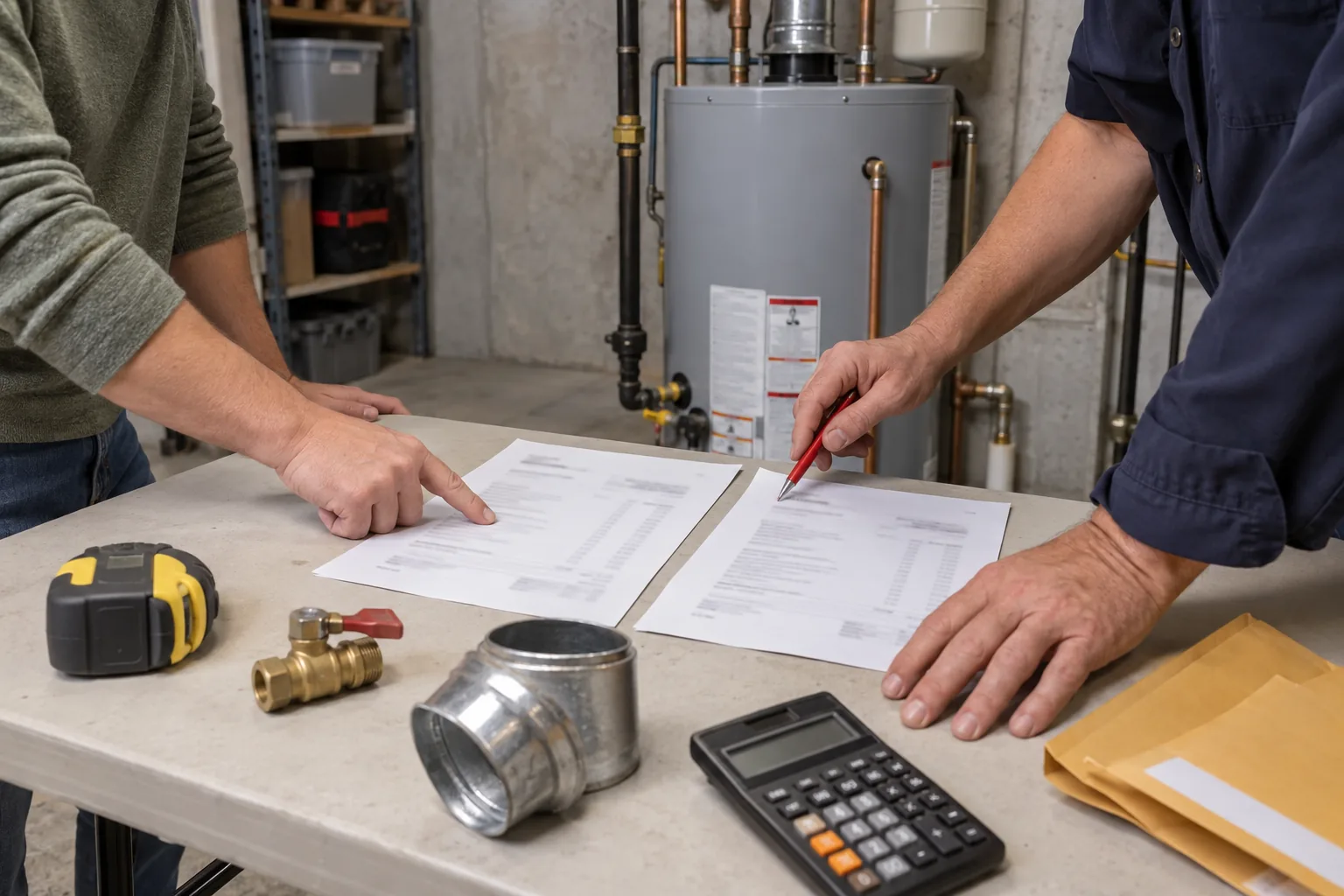
Estimate, not a final quote
This range is for planning. Final pricing depends on an on-site inspection, materials, permits, access, and contractor scope.
Compare written bids
Ask each contractor for the same scope, warranty terms, permit handling, cleanup details, and exclusions before choosing.
Source-backed guidance
Guides use public references and practical cost modeling, then point you to official sources where rules or rebates can change.
This article contains paid links to Amazon. As an Amazon Associate I earn from qualifying purchases.
Eight line items separate a real water heater quote from a phone number quoted off a truck. Most bids on the counter right now show three: a gallon size, a brand, and a total. Here's what a plumber competing for the job would actually check first.
The eight lines a complete quote has
- Efficiency, stated as UEF, not just "high efficiency." The DOE-mandated Uniform Energy Factor is the number that actually predicts your gas bill. ENERGY STAR certification requires a minimum UEF of 0.81 for gas storage tanks up to 55 gallons and 0.86 above that, and 0.95 for tankless gas units — a plain non-condensing tank typically runs well below those marks. Ask for the First Hour Rating too: it's on the DOE EnergyGuide label and tells you how much hot water the unit actually delivers in the first hour, which is a better sizing number than gallons alone.
- Venting category, named. Atmospheric (Category I) units draft naturally up a B-vent and can't run horizontally. Power-vent (Category III) and condensing (Category IV) units use a blower to push exhaust sideways through PVC to an exterior wall. Switching categories on a replacement — say, an old atmospheric tank for a condensing one — means new venting, not a reuse of what's there. If the quote says "vent as existing" on a unit that isn't a like-for-like swap, ask what changes.
- T&P valve discharge piping, to code. The relief valve itself is cheap; the discharge piping is where inspectors fail jobs. IRC Section P2804.6.1 requires it to run full-size to an air gap, rated for at least 100 psi at 180°F, with no threaded end, no in-line valve, and terminating within 6 inches (and no less than twice the pipe diameter) above the floor or drain. A rerouted discharge pipe run wrong is one of the most common re-inspection failures on a water heater swap.
- Combustion air, for gas units in a closet or utility room. A "confined space" under the fuel gas code is a room with less than 50 cubic feet of volume per 1,000 BTU of appliance input — most water heater closets qualify. That space needs high and low combustion-air openings, each sized to at least 1 square inch per 1,000 BTU and never smaller than 100 square inches, or a duct to outside air. Skip this and the flame starves for oxygen over time; nobody notices until the CO detector does.
- The code catch-up items, itemized. Whatever the plumbing code added since your old unit went in, the permit inspection checks for it now — see the table below.
- Permit, pulled by the contractor. Same rule as any trade: a plumber asking you to pull it yourself is keeping their name off the inspection record.
- The installer's license number, on the page. Water heater installation — especially gas connections and venting — requires a licensed plumber or, in states that split the trades, a licensed gas fitter. A quote with no license number printed on it is a quote you can't verify with your state board before the work starts.
- Warranty, in two parts, with the anode clause read. Manufacturer tank/parts coverage and contractor labor coverage are separate promises — tank warranties commonly run 6 to 12 years depending on the line. The catch: manufacturers like A.O. Smith exclude the anode rod itself as a "consumable maintenance part," so a 10-year tank warranty can still void early on corrosion if nobody ever checks the rod. Ask whether inspection is on the maintenance schedule the warranty assumes, not just what year it expires.
| Code catch-up line | Typical cost | Code driver |
|---|---|---|
| Thermal expansion tank | $100 – $350 | Closed system (has a pressure regulator or backflow preventer) |
| T&P discharge piping brought to code | $50 – $150 | IRC P2804.6.1 |
| Drain pan + drain line | $50 – $250 | Unit above living space or in an attic |
| Combustion air opening | $50 – $200 | Confined space per fuel gas code |
| Seismic strapping | $50 – $150 | Required in most seismic zones |
| New shutoff valve / supply lines | $50 – $200 | Old valve won't fully close |
Cost estimator
Water heater cost estimator
A budgeting range, not a quote. Move the inputs to see what changes the number.
Household size sets the capacity: tank gallons or tankless flow rate.
Estimated national cost
Typical project lands near $1,280.
If a written quote comes in above the high end, that's not automatically wrong — ask what scope is driving it.
What this assumes
- Like-for-like swap of an existing gas tank, with no new gas line or venting route.
- Sized for a 3-person household.
- Permit and haul-away of the old unit included; no drywall or repiping.
What moves this price
- 01Switching fuel or moving the unit: new gas line, venting, or circuit adds $500–$2,500.
- 02Code catch-ups: expansion tank, drain pan, seismic straps, shut-off valve.
- 03Emergency same-day replacement vs. a scheduled install.
Walk into your quotes ready
This range is your anchor. Bring these to every contractor conversation so you can tell a fair quote from a padded one.
- Is this a like-for-like swap, or does my setup need venting, gas, or electrical changes?
- Which code updates are included: expansion tank, drain pan, straps, shut-off valve?
- What's the tank warranty (6, 9, or 12 years), and does labor have its own warranty?
- Is the permit, haul-away of the old unit, and any condensate drain work in the price?
- A flat phone price that doesn't ask what fuel type or where the unit sits.
- "Code upgrades" as one unexplained lump sum instead of itemized parts.
- Pushing a tankless conversion hard without checking your gas line size first.
What actually moves on the price
- Tank tier and UEF class are real menu pricing — a baseline tank and a high-recovery or condensing model can carry a $300–$800 gap for the same gallon size.
- Timing helps outside emergency replacement. Scheduling a swap before the old unit fails, rather than after a Sunday flood, routinely avoids the 20–50% same-day premium plumbers charge for emergency dispatch.
- The deposit should be modest — 10–30%, tied to the unit showing up. A request for half down before any equipment is on site is a cash-flow ask, not a pricing one.
- Labor on the code items is not worth negotiating away. A plumber who drops the expansion tank or the discharge piping to shave $200 off the bid is deferring a $200 fix to your first flood or your first failed inspection, whichever comes first.
Before the site visit, use a tape measure to note accessible doorway widths and the space around the existing unit. Send those observations to the plumber. They are planning notes, not a substitute for the installer's required clearances or measurements.
Where the padding actually hides
The vague allowance is the most common one: "code items as needed" with no line-item price lets a $150 expansion tank become an $800 surprise after the fact. The honest version names the part and a number — "thermal expansion tank, $180, required because your system has a check valve at the meter." The bundled "water heater install" quote is the second: one price with no way to tell whether combustion air or the drain pan is even included. And the reverse red flag matters here too — a bid dramatically below the others on the same gallon size and UEF class usually means the code items are being skipped, or the tech isn't actually licensed for gas work. Both save the plumber money you never see back, right up until the inspection fails or the warranty claim gets denied.
Two flat rules
No UEF or First Hour Rating on the quote means you're buying a mystery. "50-gallon, high-efficiency" is marketing copy. The number that predicts your gas bill and your morning shower has to be on the page before you compare price to the next bid.
Don't count on a federal credit for a 2026 heat pump water heater install. The Section 25C Energy Efficient Home Improvement Credit — 30% of project cost up to $2,000 for qualifying heat pump water heaters — covers equipment placed in service through December 31, 2025. If a contractor's proposal nets a credit against your 2026 total, verify it yourself on the IRS credit page before you sign; state and utility rebates are a separate question and still worth checking directly.
If your unit is already leaking rather than sitting for a scheduled quote, sort out whether it's a $150 fitting or a failed tank first — our leaking water heater guide walks through the five-minute check. And if you're still deciding between a like-for-like tank and going tankless, the 10-year cost math is the piece to read before the quote, not after. Our replacement cost guide has the fuller price breakdown by fuel type once you're past the estimate stage.
Research sources
- ENERGY STAR: Water Heater Key Product Criteria — minimum UEF thresholds by type and capacity.
- ENERGY STAR: Water Heaters
- ICC: 2018 IRC Section P2804.6.1, Discharge Pipe Requirements
- ICC: CodeNotes — Gas Appliance Combustion, Ventilation & Dilution Air (2021 IRC/IFGC)
- IRS: Energy Efficient Home Improvement Credit
- A.O. Smith: Limited Warranty, Residential Type Water Heaters — anode rod excluded as a consumable maintenance part.
Compare local quotes
Ready to compare real quotes from water heater pros?
Use your estimate as a budget anchor, then compare written contractor bids against it before you decide. Free request, no obligation.
Disclosure: this button opens a third-party quote-matching service. If you submit its form, its contact and privacy terms apply, and SaveBricks may earn a referral fee. It never changes the prices you're quoted, and our cost ranges are set independently — see how we estimate.
The cost guide
Get the monthly cost briefing
One useful email a month: project cost ranges, contractor red flags, and practical ways to avoid an inflated quote.
No spam. Unsubscribe any time. Read our privacy policy.
More water heaters guides
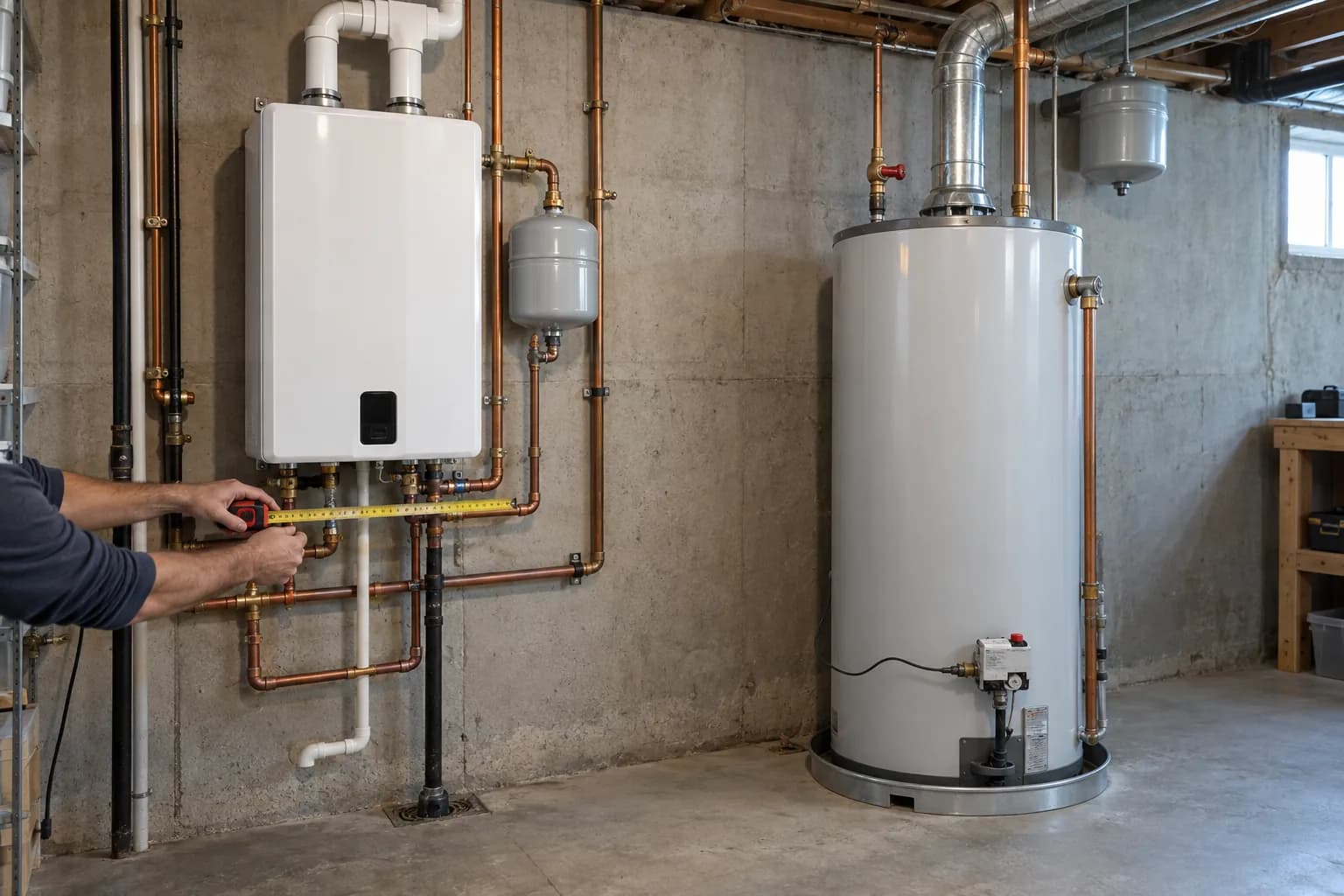
Tankless vs. Tank Water Heater: The 10-Year Cost Math
Tankless costs $1,500–$2,500 more installed. Whether you ever get that back depends on three things most sales pitches skip. Run the 10-year math first.
Read guide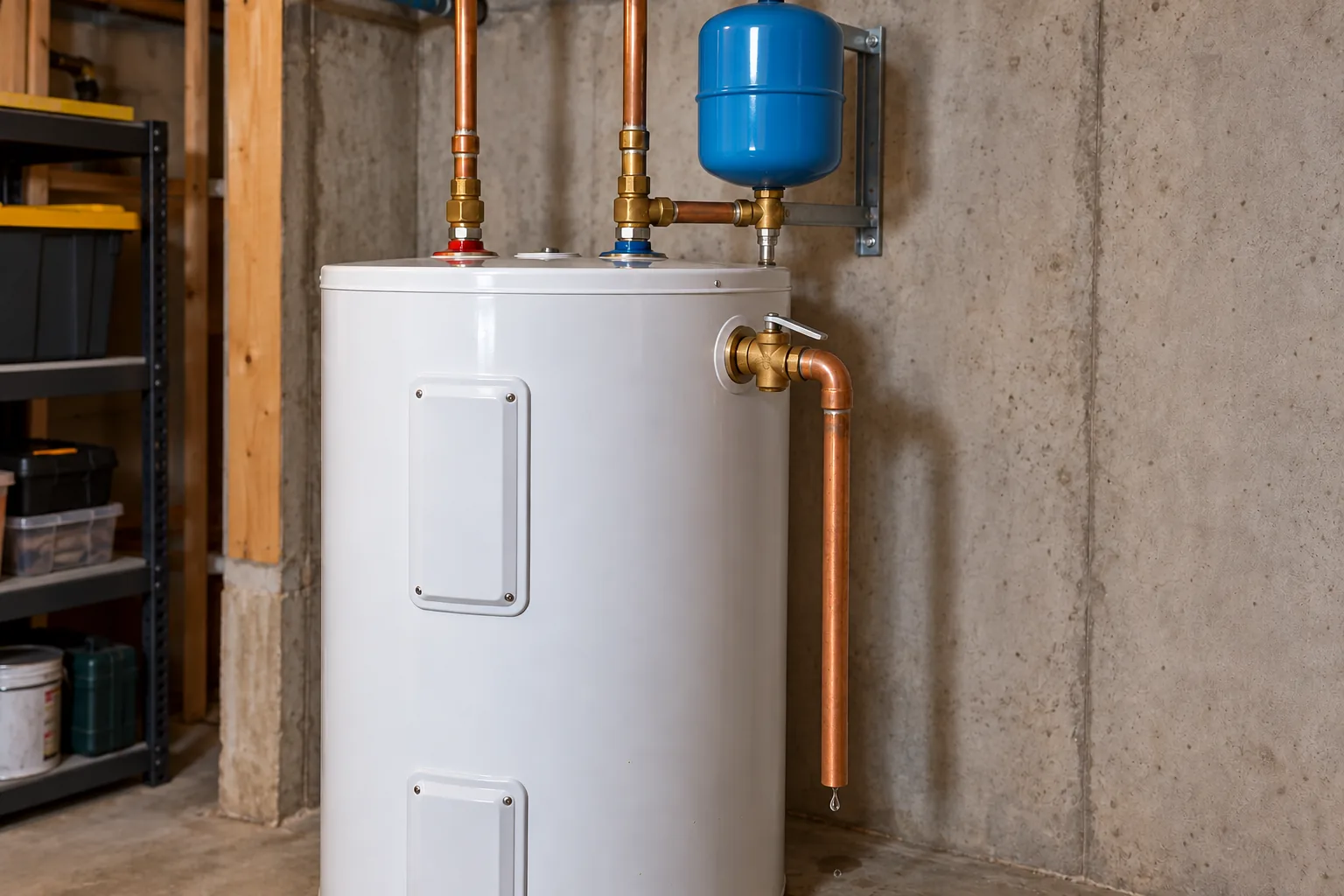
Water Heater Relief Valve Dripping? Read the Pressure Before You Replace the Valve
A T&P valve that weeps a little every heating cycle is usually doing its job in a closed system. Here's how to tell expansion from a failed valve, an overheating tank, or a bad weld.
Read guide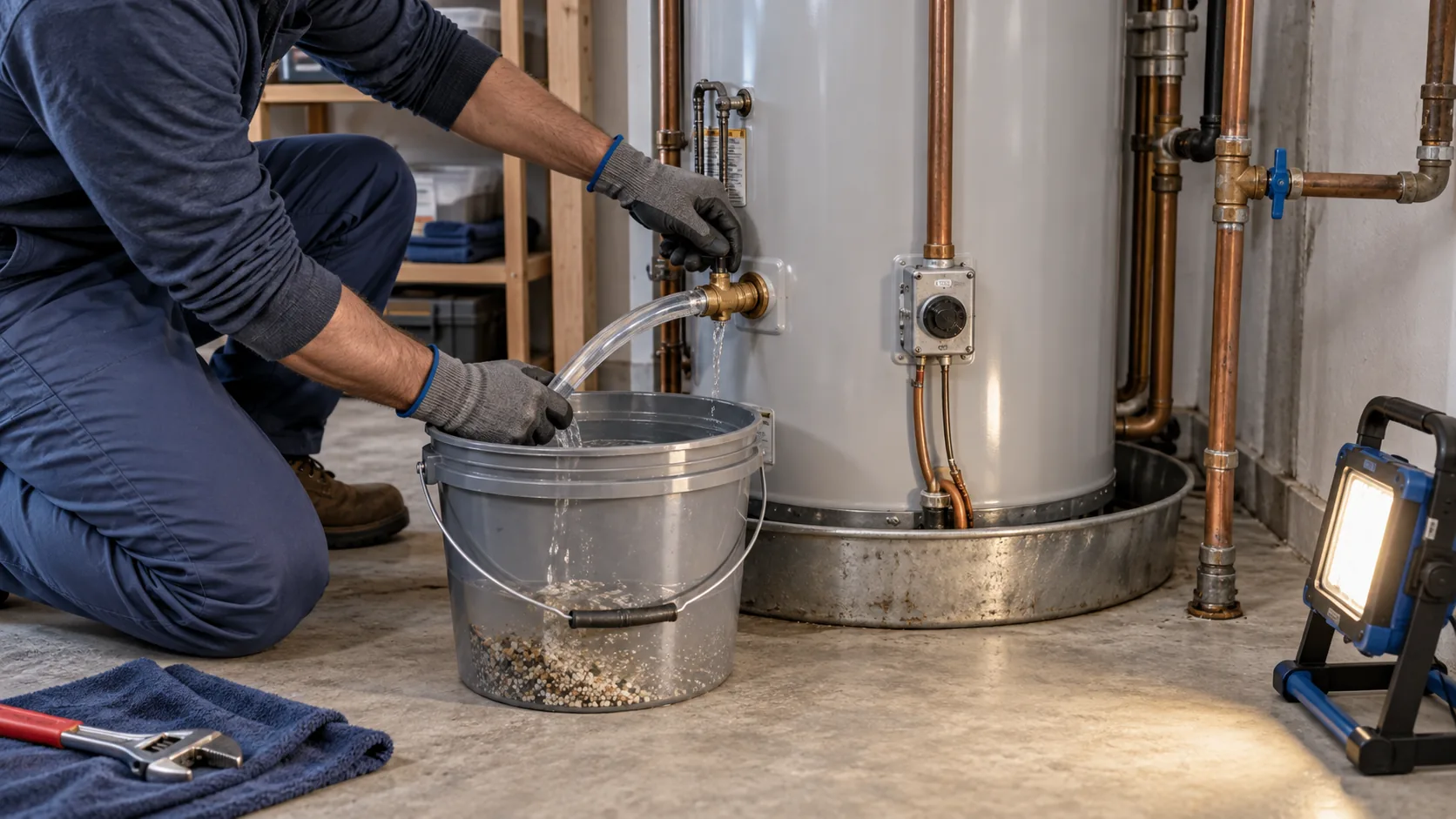
Water Heater Making a Popping Noise? Here's What's Actually Wrong
Popping or rumbling from a tank water heater is sediment trapping steam against the bottom of the tank in the vast majority of cases, not a tank about to fail. Here's how to read the sound and what fixing it costs.
Read guide