
Why does my hot water run out so fast?
A shower that goes cold halfway through is either a tank that's too small for the hour you ask of it or a part that's quietly stealing capacity. A bucket, a thermometer, and the data plate tell you which.
The short answer
Either the tank can't keep up with your busiest hour, or a part is wasting the hot water it does make. A failed lower element on an electric tank, a cracked dip tube, or a sticking mixing valve all cut usable hot water without stopping it entirely. Compare your peak-hour use against the heater's First Hour Rating first: if the demand is bigger, no repair will fix it.
Estimate, not a final quote
This range is for planning. Final pricing depends on an on-site inspection, materials, permits, access, and contractor scope.
Compare written bids
Ask each contractor for the same scope, warranty terms, permit handling, cleanup details, and exclusions before choosing.
Source-backed guidance
Guides use public references and practical cost modeling, then point you to official sources where rules or rebates can change.
This article contains paid links to Amazon. As an Amazon Associate I earn from qualifying purchases.
A standard 4,500-watt electric tank reheats about 21 gallons an hour, according to Rheem's own spec sheet. A 40,000 BTU gas tank like A.O. Smith's ProLine GCR-40 reheats about 42. That two-to-one gap means the first question isn't "what failed?" but "was this heater ever big enough for the hour you're asking of it?"
A.O. Smith's technical bulletins call "not enough hot water" an increasingly common complaint across the industry, driven partly by regulatory changes: lower factory temperature presets and shorter inlet tubes.
Three numbers that explain most cold showers
| Number | Where to find it | What it tells you |
|---|---|---|
| First Hour Rating (FHR) | EnergyGuide label or the model's spec sheet | Gallons of hot water the heater can deliver in one hour, starting from a full, hot tank |
| Recovery rate (GPH) | Spec sheet, usually stated at a 90°F temperature rise | Gallons it can reheat per hour once the stored water is gone |
| Your peak-hour demand | You, with a bucket and a clock | Gallons your household actually draws in its busiest hour |
ENERGY STAR defines FHR as the maximum volume of hot water a storage heater can supply in an hour that begins with the tank fully heated. That's why tank size alone misleads you. The FHR blends storage with recovery. A.O. Smith's GCR-40 is a 40-gallon tank with an FHR of 80 gallons, because a 40,000 BTU burner keeps refilling the tank with hot water while you use it. A 50-gallon electric tank stores more water but refills it at half the speed. For reference, ENERGY STAR won't certify a gas storage heater below 51 gallons FHR or a heat pump water heater below 45.
Measure your busiest hour
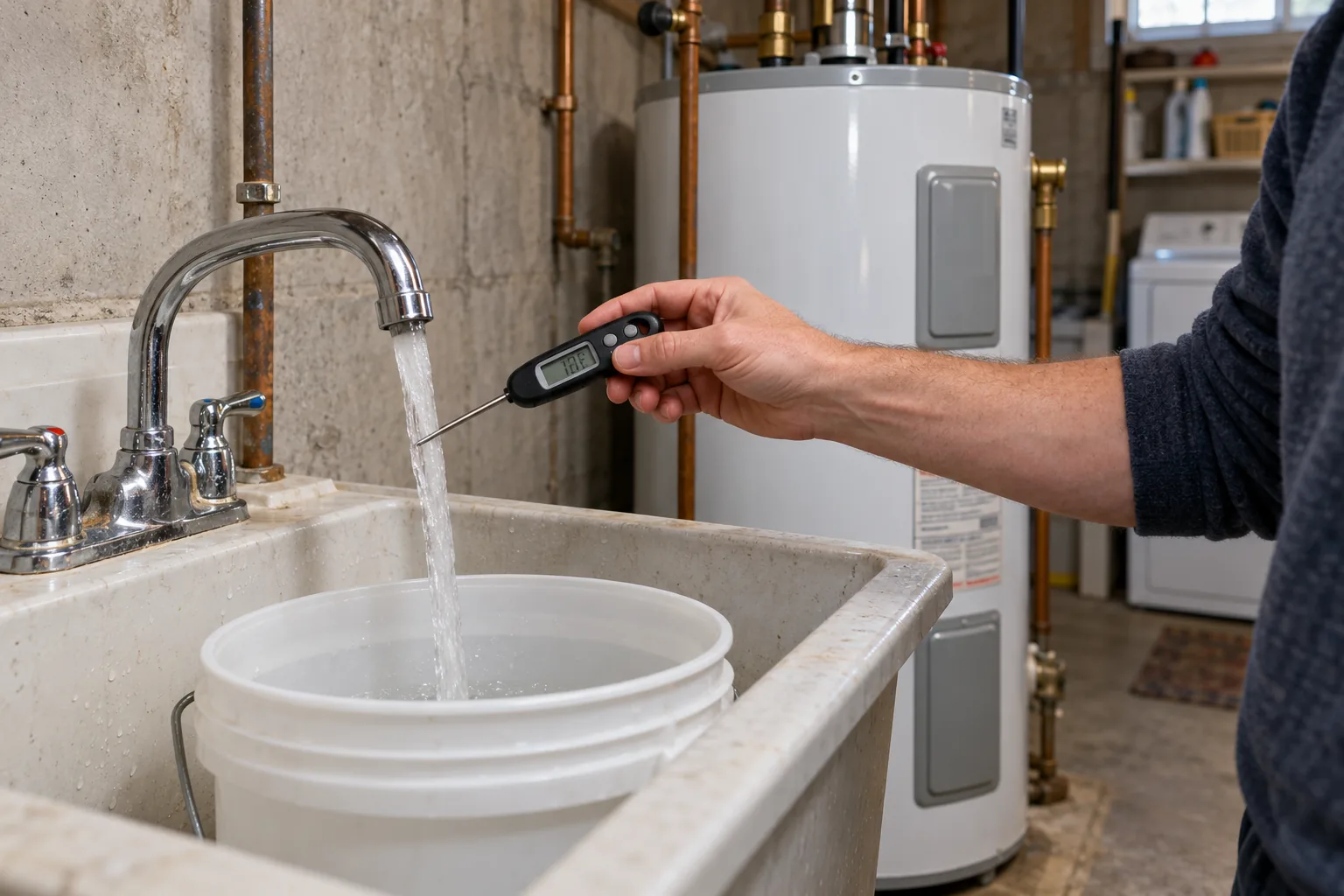
A.O. Smith's own field test for this complaint starts with a 1-gallon bucket, and so should you. Time how long the shower takes to fill it at full hot. Twelve seconds means 5 gallons per minute; twenty seconds means 3. Multiply by the minutes your household actually runs in its worst hour, adding the dishwasher or washer if they overlap. That's your peak-hour demand.
Then use a cooking thermometer to measure water from the tap nearest the heater, keeping your hands clear of the hot stream. A.O. Smith's procedure expects the outlet to read somewhere between 120°F and 140°F, and the temperature should fall only about 30°F by the time you've drawn 60% of the tank's capacity. Losing much more than that, faster than that, is the signature of a part problem, not a sizing problem.
Flat rule: if your peak-hour demand beats the heater's FHR, stop looking for a broken part. A new element or dip tube restores the heater to its rating; it can't raise the rating. A.O. Smith goes further: its Bulletin 42 says undersized heaters are not eligible for warranty consideration, because running a tank flat out shortens its life.
Cost estimator
Water heater cost estimator
A budgeting range, not a quote. Move the inputs to see what changes the number.
Household size sets the capacity: tank gallons or tankless flow rate.
Estimated national cost
Typical project lands near $1,280.
If a written quote comes in above the high end, that's not automatically wrong — ask what scope is driving it.
What this assumes
- Like-for-like swap of an existing gas tank, with no new gas line or venting route.
- Sized for a 3-person household.
- Permit and haul-away of the old unit included; no drywall or repiping.
What moves this price
- 01Switching fuel or moving the unit: new gas line, venting, or circuit adds $500–$2,500.
- 02Code catch-ups: expansion tank, drain pan, seismic straps, shut-off valve.
- 03Emergency same-day replacement vs. a scheduled install.
Walk into your quotes ready
This range is your anchor. Bring these to every contractor conversation so you can tell a fair quote from a padded one.
- Is this a like-for-like swap, or does my setup need venting, gas, or electrical changes?
- Which code updates are included: expansion tank, drain pan, straps, shut-off valve?
- What's the tank warranty (6, 9, or 12 years), and does labor have its own warranty?
- Is the permit, haul-away of the old unit, and any condensate drain work in the price?
- A flat phone price that doesn't ask what fuel type or where the unit sits.
- "Code upgrades" as one unexplained lump sum instead of itemized parts.
- Pushing a tankless conversion hard without checking your gas line size first.
If the math says it should keep up
When your demand fits inside the FHR and the water still runs out, one of these is usually why:
| What you notice | Likely cause | Who fixes it |
|---|---|---|
| Electric tank: hot for a few minutes, then cold, with a quick drop | Failed lower heating element or lower thermostat | Plumber or electrician, who checks the element with the power off |
| Shower goes lukewarm fast; white plastic flecks in faucet aerators | Cracked, short, or missing dip tube | Plumber |
| Plenty of hot water at the heater, weak hot water at one fixture | Failing thermostatic mixing valve or a single-handle shower cartridge | Plumber |
| Worse every winter, fine in summer | Colder incoming water; the heater has to add more heat per gallon | Raise the setting or add a mixing valve; nothing is broken |
| Gas tank runs short; rumbling or popping | Sediment taking up the tank floor | Flush or replace; see our popping-noise guide |
| New heat pump water heater, runs out after back-to-back showers | Unit is in heat-pump-only mode | You, via the mode setting |
The lower element. A standard electric tank has two elements, upper and lower. When only the lower one fails, the upper element still heats the top of the tank, so you get a short burst of hot water before it turns cold. A.O. Smith's electric bulletin sends technicians straight to the lower element when the outlet temperature drops more than 30°F during the draw test. Its technician guide tests the lower element's resistance at the terminals with power off. That means opening the access panel next to 240-volt wiring. Leave it to a licensed pro.
The dip tube. This plastic tube carries incoming cold water down to the bottom of the tank, where the burner or lower element can heat it. A.O. Smith lists a cracked, missing, or short dip tube among the causes of not enough hot water on gas heaters. When it fails, cold water dumps in at the top and dilutes the hot water right where the outlet draws from it. Replacing one means shutting off the water and fuel and draining the tank, so it's a plumber's job.
The mixing valve. Many tanks now feed a thermostatic mixing valve that blends in cold water to prevent scalds. A.O. Smith's troubleshooting guide notes that when one of these valves fails, it can cut the hot water reaching your shower or faucet even when the tank is full of it. Checking the temperature right at the heater outlet separates this from a heater fault in about a minute.
Winter. A.O. Smith flags seasonal swings in cold-water temperature as a common trigger for these complaints. The same 21 gallons an hour of recovery covers less shower time when the water coming in is colder. If it only happens in winter, you have a sizing margin problem, not a broken part.
New heat pump water heater? Check the mode first
Heat pump water heaters are the one case where the fix is often a button. Rheem's hybrid units ship in Energy Saver mode and also offer Heat Pump, High Demand, and Electric modes. Rheem describes High Demand as the mode with the highest recovery, because it runs the heat pump and an electric element at the same time. Heat-pump-only mode is the most efficient and the slowest to recover. If a new hybrid runs out after two showers, switch to High Demand for your busy season before you call anyone.
Shopping for a hybrid because of a tax credit? That's gone. The IRS says the Energy Efficient Home Improvement Credit can't be claimed for property placed in service after December 31, 2025, so a 2026 installation doesn't get the 30% credit that heat pump water heaters used to qualify for.
Repair, resize, or replace
A.O. Smith puts the average service life of a tank water heater at 8 to 12 years. Past 10 years, replace it instead of repairing it. That's the manufacturer's own guidance too. A 12-year-old tank with a failed dip tube still has 12-year-old steel around it.
If the heater is younger and the gallon math fits, repair the part. Element, dip tube, and mixing-valve repair prices depend on your local labor rate, whether the tank has to be drained, and whether the part is still under warranty. Get a written quote that names the specific part before you approve the work.
If the gallon math doesn't fit, the honest fix is a heater with a higher FHR. That might be a gas unit with a bigger burner, a larger tank, or a hybrid set to High Demand. A.O. Smith puts typical tank installations at $1,000 to $2,500, more if the venting or gas line has to change. Our quote guide shows how to check that the bid lists the FHR and not just the gallons.
Stop and call a pro straight away if the water at the heater is above 140°F, if the T&P relief valve's discharge pipe is dripping or steaming, or if you smell gas. None of those is a capacity problem.
Research sources
- ENERGY STAR: Water Heater Key Product Criteria — FHR definition; 51-gallon gas storage and 45-gallon heat pump minimums.
- A.O. Smith: Technical Bulletin #35, Not Enough Hot Water — Gas — bucket flow test, 120°F–140°F outlet range, dip tube causes.
- A.O. Smith: Technical Bulletin #36, Not Enough Hot Water — Electric — regulatory causes, ~30°F drop at 60% draw, lower element and dip tube checks.
- A.O. Smith: Technical Bulletin #42, Undersizing — undersized heaters not eligible for warranty consideration.
- A.O. Smith University: Standard Electric — Not Enough Hot Water / Thermostatic Mixing Valve (PDF) — lower element test, seasonal complaints, mixing valve failure.
- A.O. Smith: ProLine GCR-40 product page — 40,000 BTU, 80-gallon FHR, 42 GPH recovery.
- Rheem: Professional Classic Residential Electric spec sheet (PDF) — 4,500 W element recovery of 21 GPH at a 90°F rise.
- Rheem: Understanding Hybrid Electric Heat Pump Water Heater Operating Modes — Energy Saver, Heat Pump, High Demand, and Electric modes.
- A.O. Smith: When to Repair or Replace Your Water Heater — 8-to-12-year service life; replacement past 10 years.
- A.O. Smith: How Much Does Water Heater Installation Cost? — tank installation cost range.
- IRS: Energy Efficient Home Improvement Credit — no credit for property placed in service after December 31, 2025.
Compare local quotes
Ready to compare real quotes from water heater pros?
Use your estimate as a budget anchor, then compare written contractor bids against it before you decide. Free request, no obligation.
Disclosure: this button opens a third-party quote-matching service. If you submit its form, its contact and privacy terms apply, and SaveBricks may earn a referral fee. It never changes the prices you're quoted, and our cost ranges are set independently — see how we estimate.
The cost guide
Get the monthly cost briefing
One useful email a month: project cost ranges, contractor red flags, and practical ways to avoid an inflated quote.
No spam. Unsubscribe any time. Read our privacy policy.
More water heaters guides
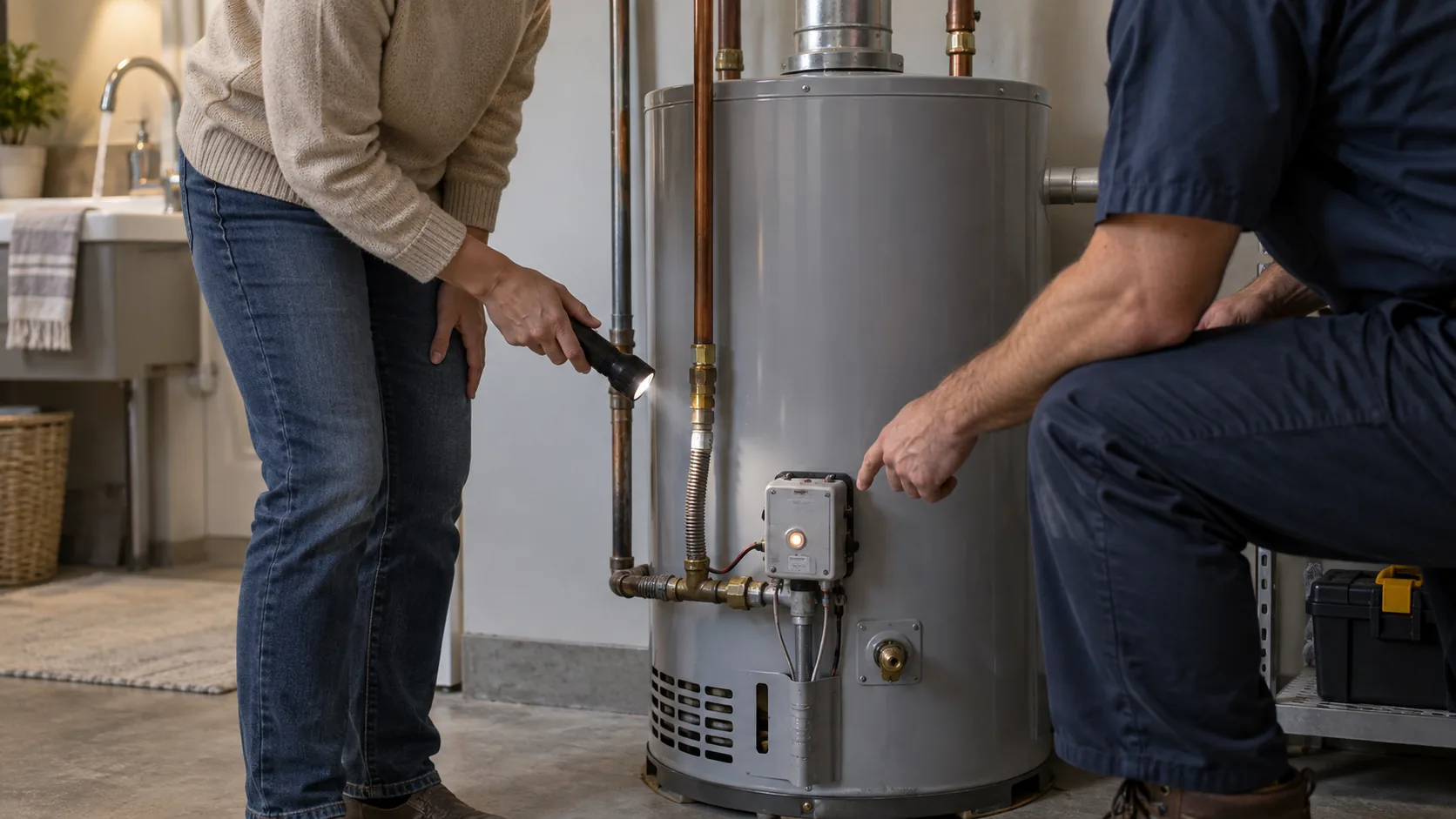
No Hot Water? Gas or Electric Decides Which Part Quit
A tank that suddenly runs cold has usually lost one specific part, and the fuel type tells you which ones to suspect. Here's how to narrow it down before the service call.
Read guide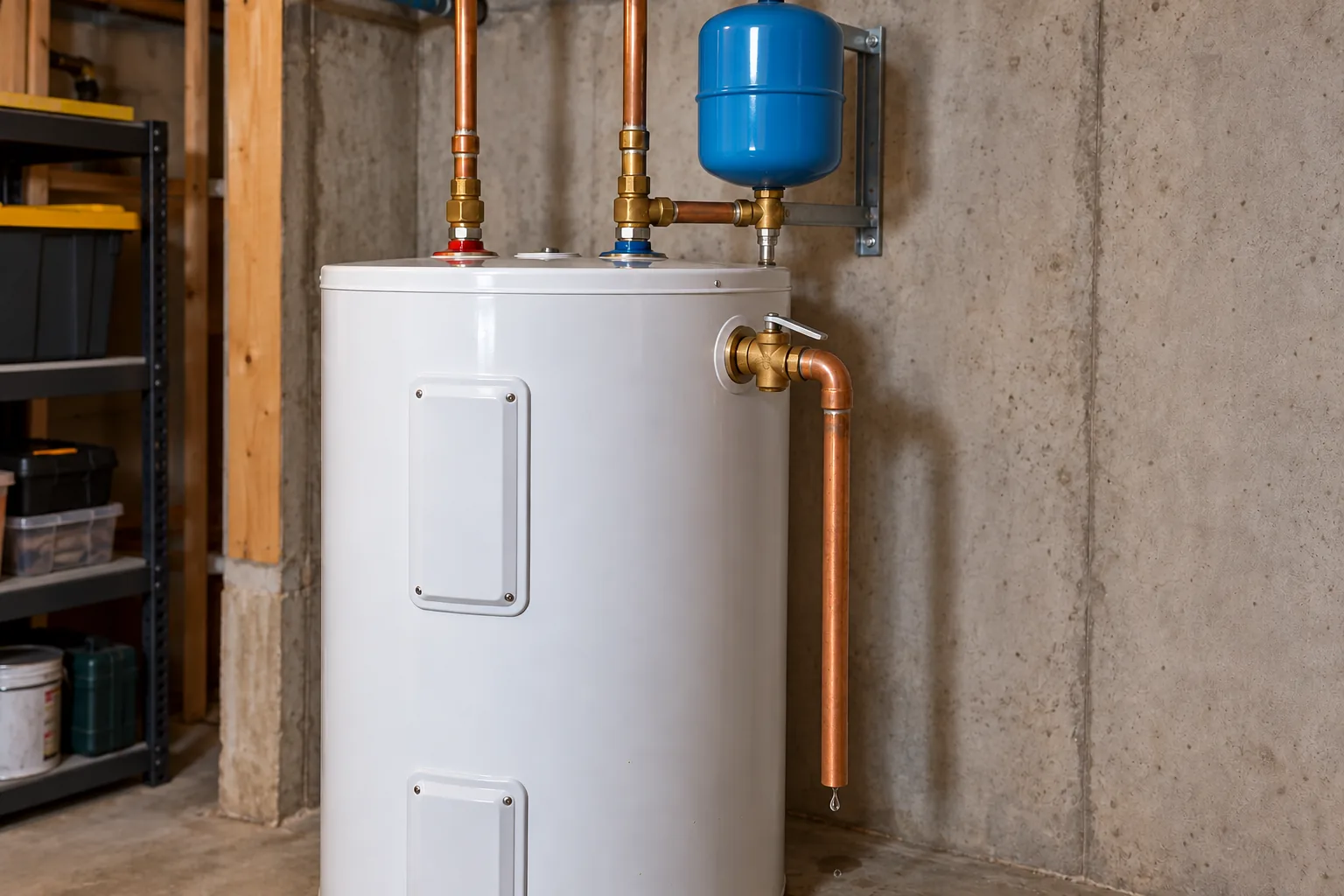
Water Heater Relief Valve Dripping? Read the Pressure Before You Replace the Valve
A T&P valve that weeps a little every heating cycle is usually doing its job in a closed system. Here's how to tell expansion from a failed valve, an overheating tank, or a bad weld.
Read guide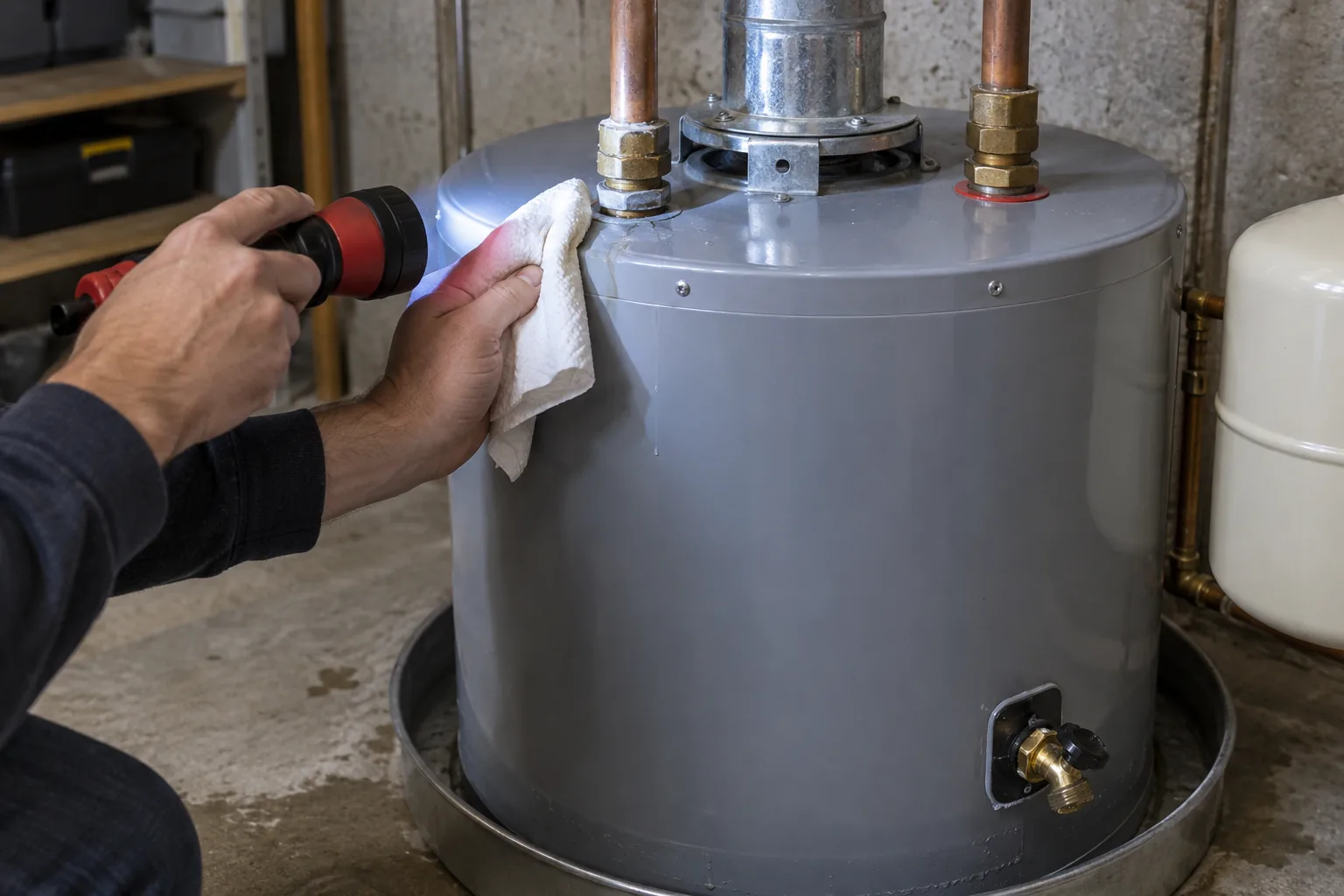
Water Heater Leaking? Where the Water's From Decides Everything
A leak from a fitting is a $150 fix. A leak from the tank body is a replacement, today. How to tell the difference in five minutes, before you call.
Read guide