
Some shingles blew off my roof in a storm. Can they just be replaced, or do I need a new roof?
The shingle on your lawn is the cheap part of wind damage. The broken sealant bonds still on the roof decide whether you need a patch, a slope, or a new roof.
The short answer
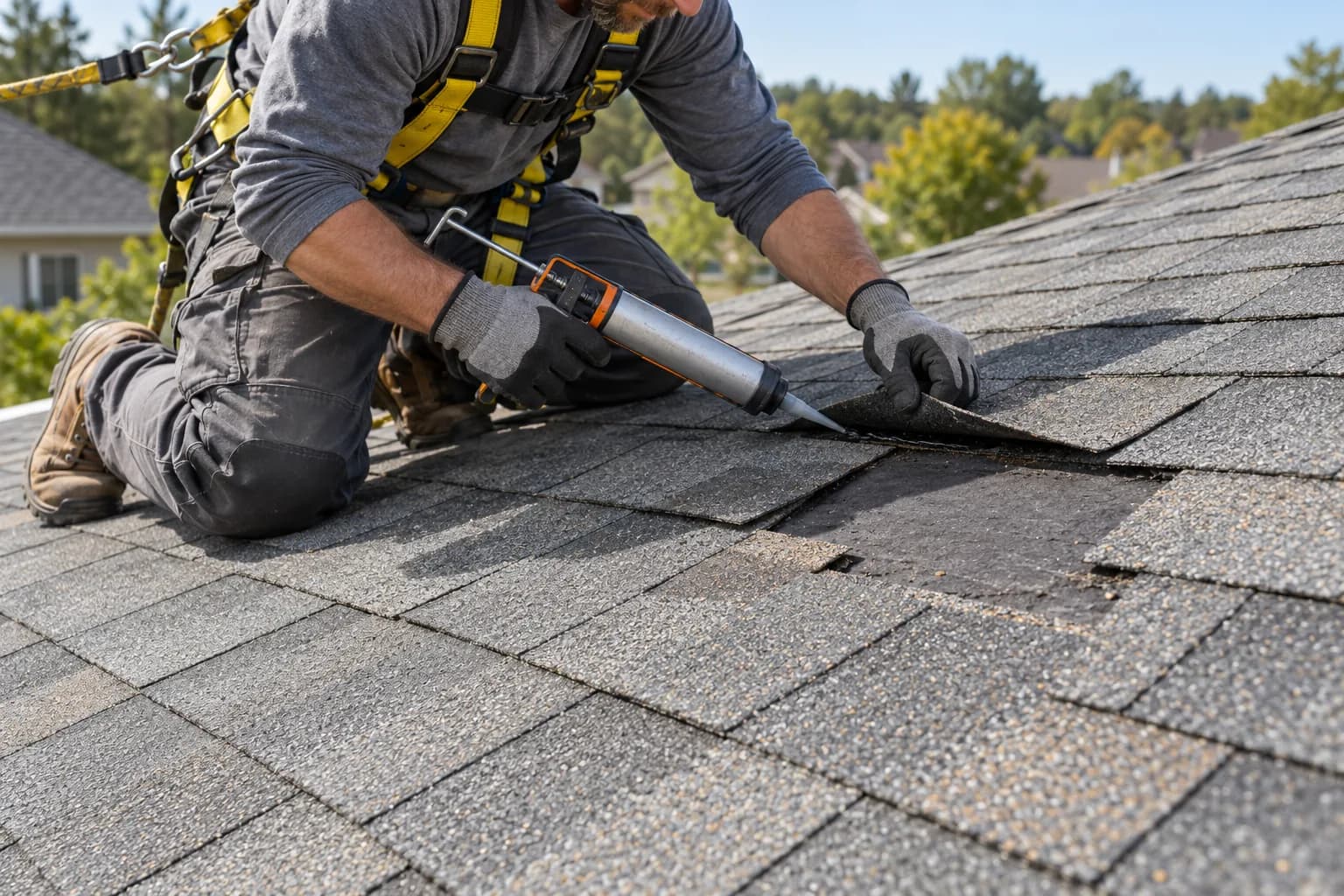
A few missing shingles on an otherwise sound roof are usually a patch job, often in the low hundreds of dollars once the service-call minimum is covered. What changes the answer is the shingles that stayed on but had their sealant bonds broken: GAF's own technical guidance says those are unlikely to re-seal on their own and need hand-sealing. If lifted or creased tabs run across several slopes of an older roof, price a replacement alongside the repair.
Estimate, not a final quote
This range is for planning. Final pricing depends on an on-site inspection, materials, permits, access, and contractor scope.
Compare written bids
Ask each contractor for the same scope, warranty terms, permit handling, cleanup details, and exclusions before choosing.
Source-backed guidance
Guides use public references and practical cost modeling, then point you to official sources where rules or rebates can change.
This article contains paid links to Amazon. As an Amazon Associate I earn from qualifying purchases.
Three shingles in your yard after a windstorm usually means three shingles missing and a few dozen more that lifted, broke their seal, and dropped back into place looking fine. GAF's September 2025 technical bulletin on extraordinary wind events is blunt about the second group: when sealant bonds are broken, it is unlikely the shingles will re-seal on their own. Those are the shingles that blow off in the next storm, and they are what separates a $300 repair from a much larger bill.
Why shingles let go
A modern asphalt shingle is held down two ways. Nails go through a narrow band in the middle of the shingle, and IRC Section R905.2.6 requires at least four fasteners per strip shingle, or more if the manufacturer calls for it. Above the exposed tab, a factory-applied asphalt sealant strip softens in sunlight and bonds to the course above. That bond is what keeps wind from getting under the leading edge.
Wind lifts the leading edge, peels the sealant bond, then levers the shingle against its nails until the mat tears. So a missing shingle is the end of a sequence, and the shingles around it have usually been through the first half of it.
Three conditions make that sequence start sooner:
- Cold-season installs. Sealant strips need heat to activate. A roof put on in late fall may go through its first winter with tabs that were never bonded.
- Age. GAF's bulletin says a repair's strength depends on the product's age, its sun and heat exposure, and sustained stress from high winds. An old shingle is brittle, and its sealant is spent.
- Edges. Eaves, rakes, and ridges see the highest uplift. That's why manufacturers call for starter strips at the eaves and rakes and matched hip-and-ridge caps.
Read the damage from the ground
Don't go up. A wet or wind-loosened roof is a fall hazard even for people who work on roofs daily, and walking on lifted tabs can crack them. Binoculars from the yard and a flashlight for safely accessible attic areas help you document what a roofer needs. Use your phone's zoom if you already have it; you do not need new equipment to report damage.
| What you see | What it usually means | What the fix involves |
|---|---|---|
| Bare strip of underlayment or deck showing | Shingles torn off at the nail line | Replace shingles, check the underlayment |
| Shingles present but edges lifted or wavy | Sealant bond broken | Hand-seal each affected shingle |
| Horizontal crease line across tabs | Tab folded back in the wind; mat is cracked | Replace. A creased tab won't shed water reliably |
| Ridge cap pieces missing | Highest-uplift zone failed first | Replace caps with the manufacturer's matched ridge product |
| Dark patches with granules in the gutters | Granule loss from wind or debris | Replace shingles that were nailed through the damaged area |
| Daylight or a fresh wet stain on attic decking | Water already past the roof | Emergency cover now, repair scope after |
The creased-tab row is the one people miss. A tab that folded back and dropped down looks almost normal from the street, but the crease is a crack through the shingle, and it's usually a replacement rather than a sealing job.
Cost estimator
Roofing cost estimator
A budgeting range, not a quote. Move the inputs to see what changes the number.
Estimated national cost
Typical project lands near $11,750.
If a written quote comes in above the high end, that's not automatically wrong — ask what scope is driving it.
What this assumes
- Asphalt shingle material selected.
- 1,500 sq ft house size selected.
- Standard tear-off and replacement scope assumed.
What moves this price
- 01Roof pitch, height, access, and number of layers.
- 02Decking repairs, ventilation, flashing, and underlayment.
- 03Permit requirements, disposal fees, and local labor rates.
Walk into your quotes ready
This range is your anchor. Bring these to every contractor conversation so you can tell a fair quote from a padded one.
- Is this a full tear-off or a layover, and how many layers are on there now?
- What underlayment, flashing, and ventilation work is included?
- Who pulls the permit, and is disposal of old material in the price?
- What's the workmanship warranty versus the shingle manufacturer's warranty?
- A bid far below every other, usually meaning a layover or skipped flashing.
- Asking for a large deposit before any material is delivered.
- No written scope listing tear-off, underlayment, and ventilation.
What a proper wind repair includes
A repair quote that says "replace missing shingles" and nothing else leaves out most of the work. Ask for these in writing:
- Count of shingles replaced, by slope.
- Hand-sealing of lifted shingles, with a count. GAF's R-126 bulletin specifies a minimum of three 1-inch spots of asphalt roofing cement, evenly spaced under each hand-sealed shingle. A roofer who skips this is leaving you the next storm's damage.
- Nailing to code and to the manufacturer. Four nails per strip shingle is the IRC floor. Manufacturers often require a "special installation" with extra fasteners before their higher wind coverage applies, so ask which one you're getting.
- No caulked nail holes. Per the same GAF bulletin, shingles that failed from granule loss where nails went through must be replaced. Caulking those holes is not a permanent repair and isn't covered by the warranty.
- Photos before and after. They're your insurance record and your proof the tabs were sealed.
Matching is the practical problem. Shingle colors weather and lines get discontinued, so a patch on a 15-year-old roof will often show. That's cosmetic, not structural. How your insurer treats a visible mismatch depends on the policy. Our roof insurance claim checklist covers documenting it.
What it usually costs
| Scope | Typical bid range | What moves it |
|---|---|---|
| Service call, few shingles, one slope | ~$150–$400 | The roofer's trip minimum, often $150–$300 on its own |
| Missing shingles plus hand-sealing across a slope | ~$300–$800 | Number of lifted tabs, pitch, two-story access |
| Multiple slopes, ridge caps, some creased tabs | ~$600–$1,500 | Ridge product, harness and safety setup, matching |
| Full tear-off and replacement | $9,000–$16,000 | Roof area, layers, decking condition |
The three repair ranges come from contractor bids and published field ranges, not from a standards body. Use them to spot outliers. Materials are rarely the expense. A few shingles cost little; the charge is for putting a crew and a harness on your roof.
Repair or replace
Here's the rule. Damage on one or two slopes, a roof under about 15 years old, tabs still flexible: repair and hand-seal. Lifted or creased tabs on most slopes of a roof past about 20 years: stop paying for patches and price a replacement. Those year marks are our judgment, not a code number, and they rest on GAF's point that repair strength falls with the product's age and sun exposure. An old shingle that has been hand-sealed is still an old shingle.
Two code lines can decide it for you. IRC Section R908.3.1.1 doesn't allow a new layer over a roof that already has two or more layers, so a second layer on a two-layer roof means a full tear-off. And if the existing roof is water-soaked or has deteriorated to the point it can't serve as a base, a recover isn't allowed either.
Don't count on the shingle warranty to pay for storm damage. GAF's warranty comparison lists 110 mph maximum wind coverage for Timberline and Designer installs that don't qualify for its WindProven warranty, or 130 mph with special installation. Its WindProven warranty drops the speed limit for 15 years, but only on Timberline shingles with LayerLock installed with at least four qualifying GAF accessories. And GAF's R-126 bulletin says damage from extraordinary weather, including hurricanes over the wind limit, tornadoes, and microbursts, is excluded from its limited warranties. After a major storm, the payer is usually your homeowner's policy, not the manufacturer.
If you replace, buy the wind rating on purpose
Shingle wind ratings come from two tests, and the class should be printed on the bundle wrapper. IRC Section R905.2.4.1 requires testing to ASTM D7158, with ASTM D3161 as the fallback for shingles outside that standard's scope, and the package must carry the classification label.
| Test | Classes | What they represent |
|---|---|---|
| ASTM D3161 (fan-driven air) | A / D / F | Passed at 60 / 90 / 110 mph |
| ASTM D7158 (uplift resistance) | D / G / H | Rated for basic wind speeds of 90 / 120 / 150 mph |
Your local code sets the minimum class based on the design wind speed where you live. If your roof just lost shingles in a storm that wasn't a hurricane, ask for Class F or Class H on the quote, plus the manufacturer's starter strip at eaves and rakes and its matched ridge cap. The architectural vs. 3-tab comparison covers what that usually costs.
Tonight, and the next few days
If water is coming in, this is a same-day call for an emergency cover. A roofer will tarp the opening. Don't climb up to do it yourself in wind or rain. Inside, move what you can, catch the drip, and photograph everything before cleanup.
The knock on your door comes next. The FTC warns that people offering roof repairs often show up right after windstorms and push you to act fast and pay in cash. Its advice is to check licenses and insurance, get three written estimates, sign a written contract before work starts, and never pay by cash or wire transfer.
Research sources
- ICC: 2018 International Residential Code, Chapter 9 Roof Assemblies: R905.2.4.1 wind-resistance testing and labeling, R905.2.6 minimum fasteners, and R908.3.1.1 limits on roof recover.
- NRCA / Professional Roofing: The wind resistance of shingles (PDF): ASTM D3161 Class A/D/F and ASTM D7158 Class D/G/H definitions.
- GAF Technical Bulletin R-126: Replacement of Storm-Damaged Shingles (PDF): storm-damage warranty exclusion, the three-spot hand-sealing minimum, and no caulking of nail-through granule loss.
- GAF Technical Bulletin R-143: Damage to Shingles Caused by Extraordinary Wind Events (PDF): forms of wind damage, broken sealant bonds unlikely to re-seal, and factors that affect repair strength.
- GAF: Residential Roof Warranty Comparison: 110/130 mph maximum wind coverage and WindProven eligibility.
- FTC Consumer Advice: Four ways to avoid scams after a weather-related disaster: post-storm contractor red flags.
- FTC Consumer Advice: Home Repair Scams: licenses, three written estimates, a written contract, and no cash or wire payment.
Compare local quotes
Ready to compare real quotes from roofing pros?
Use your estimate as a budget anchor, then compare written contractor bids against it before you decide. Free request, no obligation.
Disclosure: this button opens a third-party quote-matching service. If you submit its form, its contact and privacy terms apply, and SaveBricks may earn a referral fee. It never changes the prices you're quoted, and our cost ranges are set independently — see how we estimate.
The cost guide
Get the monthly cost briefing
One useful email a month: project cost ranges, contractor red flags, and practical ways to avoid an inflated quote.
No spam. Unsubscribe any time. Read our privacy policy.
More roofing guides

Black Streaks on Your Roof? Check the Warranty Before You Pay a Cleaner
Dark streaks running down asphalt shingles are almost always algae, not damage. Here's how to tell it from moss, who may pay to clean it, and why it's never a reason to re-roof.
Read guide
Shingle Granules in Your Gutters? Roof Age and Bare Spots Decide It
Grit at the downspout is normal on a new roof and a warning on a storm-hit one. Here's how to tell which, what an inspection costs, and who pays for the fix.
Read guide
3-Tab vs. Architectural Shingles: Cost and Quote Comparison
Compare 3-tab and architectural asphalt shingles by installed price, wind rating, warranty, roof details, and the line items that make two bids differ.
Read guide