
Is it a problem if I'm finding shingle granules in my gutters?
Grit at the downspout is normal on a new roof and a warning on a storm-hit one. Here's how to tell which, what an inspection costs, and who pays for the fix.
The short answer
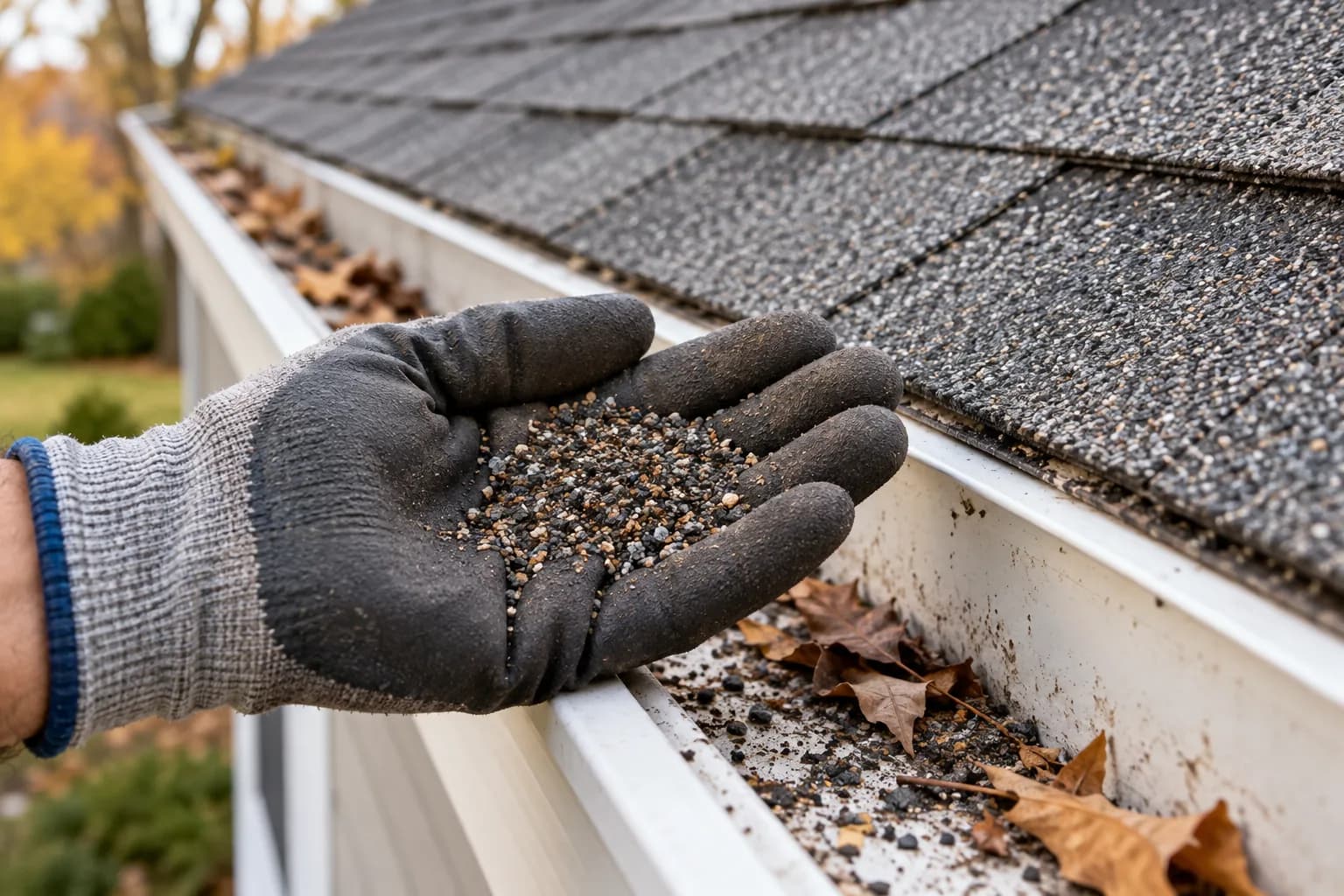
On a roof installed in the last two years, granules in the gutters are usually excess factory granules washing off, and manufacturers like IKO and Malarkey say that shedding doesn't shorten the shingle's life. It becomes a problem when you can see bare black asphalt on the shingles, or when the loss is bunched on one slope after a hailstorm. In either case, get a professional inspection before you price a new roof.
Estimate, not a final quote
This range is for planning. Final pricing depends on an on-site inspection, materials, permits, access, and contractor scope.
Compare written bids
Ask each contractor for the same scope, warranty terms, permit handling, cleanup details, and exclusions before choosing.
Source-backed guidance
Guides use public references and practical cost modeling, then point you to official sources where rules or rebates can change.
Malarkey's technical bulletin on granule shedding gives a window of six months to two years, depending on climate, for a new shingle roof to stop dropping noticeable grit. Inside that window, a gutter full of granules after a hard rain is usually the roof doing exactly what it was built to do. Outside it, the same handful of grit can mean storm damage or a roof running out of life.
The granules themselves aren't decoration. IKO's product bulletin explains that they shield the asphalt coating from UV, and that manufacturers press in more than the shingle needs so the asphalt is fully covered. The extra ones, which the industry calls "hitchhikers," sit loose on the surface, and some end up in the bundle. Those are what you're seeing first.
First, ask whose granules they are
Before you read anything into the grit, check one thing: were the gutters replaced with the roof? Malarkey's bulletin points out that plenty of homeowners get a new roof and keep the old gutters, so granules sitting in them may have come from the previous roof. Old sediment packed into the bottom of a gutter, under leaves, tells you nothing about the shingles above it.
You don't need a ladder to get a fresh sample. Set a bucket or a fine-mesh bag under one downspout outlet before a decent rain, and look at what collects. Fresh grit from a single storm is the evidence that counts. Ladder work at the eave is a fall hazard, so if you'd have to climb to check them, leave it for whoever cleans them.
Roof age sets the default answer
| Roof age | What granules in the gutter usually mean | What to do | Typical cost |
|---|---|---|---|
| Under 6 months | Hitchhiker granules from manufacturing and install traffic | Nothing. Clean gutters on your normal schedule | $0 |
| 6 months to 2 years | Shedding tapering off; Malarkey's window, varying by climate | Watch whether the amount drops rain to rain | $0 |
| 2+ years, light and even | Normal weathering over the roof's life | Keep watching; note it on your fall checklist | $0 |
| Any age, after hail or a severe windstorm | Possible impact damage | Professional inspection before the claim deadline | Often $150–$400 |
| Any age, bare asphalt visible | The coating is exposed to UV | Inspection now; repair or replacement scope to follow | Inspection plus repair; full asphalt tear-off often $8,000–$16,000 |
The inspection and replacement figures aren't from a primary source. They're market ranges from cost aggregators, and they move with your region, roof size, pitch, number of existing layers, and whether the inspection includes the attic. Many roofers inspect for free when they're bidding the repair; a paid inspection from someone who isn't selling the fix is worth it when you're deciding whether to file a claim.
Cost estimator
Roofing cost estimator
A budgeting range, not a quote. Move the inputs to see what changes the number.
Estimated national cost
Typical project lands near $11,750.
If a written quote comes in above the high end, that's not automatically wrong — ask what scope is driving it.
What this assumes
- Asphalt shingle material selected.
- 1,500 sq ft house size selected.
- Standard tear-off and replacement scope assumed.
What moves this price
- 01Roof pitch, height, access, and number of layers.
- 02Decking repairs, ventilation, flashing, and underlayment.
- 03Permit requirements, disposal fees, and local labor rates.
Walk into your quotes ready
This range is your anchor. Bring these to every contractor conversation so you can tell a fair quote from a padded one.
- Is this a full tear-off or a layover, and how many layers are on there now?
- What underlayment, flashing, and ventilation work is included?
- Who pulls the permit, and is disposal of old material in the price?
- What's the workmanship warranty versus the shingle manufacturer's warranty?
- A bid far below every other, usually meaning a layover or skipped flashing.
- Asking for a large deposit before any material is delivered.
- No written scope listing tear-off, underlayment, and ventilation.
Spread out or bunched up
The pattern on the roof matters more than the amount in the gutter. Factory shedding and normal aging are spread across every slope at roughly the same rate. Hail is not. GAF's technical bulletin on hail damage describes granule loss at the points of impact, sometimes with a small depression, and warns that hail can also cause a gradual loss of granules that leads to premature aging of the shingles over time.
That gradual part is why a roof can look fine the week after a storm and shed heavily the following spring. GAF's separate bulletin on storm-damaged shingles lists granule loss among the forms of damage that can show up immediately or years later, and it is plain that granule loss from a storm is not just cosmetic: it leaves the asphalt directly exposed to the weather.
You can check for the storm signature without going on the roof. GAF suggests looking for dents in metal flashing, siding, chimney caps, and skylight flashing when the shingles themselves aren't conclusive. From the ground, look at:
- Gutters and downspouts. Fresh dings in aluminum are a good sign hail was big enough to hit hard.
- The sun-facing and windward slopes. If granules are coming off one face of the roof and not the others, that face took the weather.
- Chimney caps and skylight flashing. Dents in soft metal up high back up what the shingles suggest.
Photograph all of it with the date. If you're going to file, our roof insurance claim guide covers how to build the file.
Bare spots are the line
Here's the flat rule: granules in the gutter are a reason to look; bare asphalt on the shingle is a reason to act. IKO's bulletin draws the line in the same place, saying granule loss only becomes a concern for shingle performance when bare spots of coating asphalt are exposed on the surface.
Bare spots look like dark, smooth patches where the shingle's colored surface is gone. Binoculars or a phone camera zoomed from the yard will usually show them on a lower slope. If they're on one slope of an otherwise sound roof, a targeted repair is often the scope. If they're on several slopes of an older roof, price a replacement next to the repair; patching shingles that are failing everywhere just buys you a second service call.
Don't go up to look closer. NRCA's guidance after severe weather is that homeowners should not attempt roof repairs themselves and that both damage assessment and repairs belong with a professional roofing contractor. A storm-roughened, granule-shedding surface is also a slippery one.
Who pays: warranty, insurance, or you
The answer depends on what caused the loss, not on how much grit you found.
Normal shedding is nobody's claim. IKO states that hitchhiker granule loss doesn't reduce the weatherproofing life of the shingles, and Malarkey says it doesn't affect performance or lifecycle and isn't a manufacturing defect.
Storm damage goes to your homeowners insurer, not the shingle maker. GAF's R-126 bulletin says extraordinary weather-related damage is specifically excluded from its warranty coverage. Dated photos and an inspection report naming impact points will carry more weight with an adjuster than a bag of granules.
Premature loss with no storm, such as bare spots on a roof only a few years old, is the warranty conversation. Start with the installer, then the manufacturer. Read the prorating clause first: GAF's limited warranty, for example, defines a non-prorated early period it calls Smart Choice Protection, and once that period ends, any remedy is reduced to reflect the use you've already gotten from the shingles. The length of that period depends on the product line and the kind of coverage, so pull your own warranty paperwork rather than assuming.
The door-knocker with a handful of grit
After a hailstorm, someone may show up at your door holding granules from your own gutter as proof you need a new roof. Granules alone don't prove that, as every section above shows. The FTC's home improvement guidance lists contractors who knock on your door because they're "in the area," pressure to decide on the spot, and demands for full payment up front or cash only as warning signs. It also recommends getting several written estimates and a written contract with the contractor's license number.
A legitimate roofer can show you photos of impact marks or bare spots on your actual shingles. If all they can show you is the gutter, get a second inspection before you sign anything. And if your roof is under two years old and the grit is spread evenly, you can probably skip the inspection and just clean the gutters.
For what a replacement bid should look like once you get there, read our roofing estimate guide.
Research sources
- IKO: TBR02 Excess Roofing Granules on Shingles, Product Bulletin
- Malarkey Roofing Products: Technical Bulletin, Granule Sloughing (PDF)
- GAF: TAB-R-108, Damage to Shingles Caused by Hail (PDF)
- GAF: R-126, Replacement of Storm Damaged Shingles (PDF)
- GAF: Roofing System Limited Warranty, Legal Sample (PDF)
- NRCA: NRCA urges building owners affected by recent severe weather to use caution when repairing their roof systems
- FTC: How to Avoid a Home Improvement Scam
Compare local quotes
Ready to compare real quotes from roofing contractor pros?
Use your estimate as a budget anchor, then compare written contractor bids against it before you decide. Free request, no obligation.
Disclosure: this button opens a third-party quote-matching service. If you submit its form, its contact and privacy terms apply, and SaveBricks may earn a referral fee. It never changes the prices you're quoted, and our cost ranges are set independently — see how we estimate.
The cost guide
Get the monthly cost briefing
One useful email a month: project cost ranges, contractor red flags, and practical ways to avoid an inflated quote.
No spam. Unsubscribe any time. Read our privacy policy.
More roofing guides

Black Streaks on Your Roof? Check the Warranty Before You Pay a Cleaner
Dark streaks running down asphalt shingles are almost always algae, not damage. Here's how to tell it from moss, who may pay to clean it, and why it's never a reason to re-roof.
Read guide
Shingles Blown Off in a Windstorm? Count the Lifted Tabs, Not the Missing Ones
The shingle on your lawn is the cheap part of wind damage. The broken sealant bonds still on the roof decide whether you need a patch, a slope, or a new roof.
Read guide
Ice Dams on Your Roof? Here's What's Actually Causing Them
An ice dam is an attic heat problem showing up at the gutter line. Here's what removal costs this winter, and the fix that keeps it from coming back.
Read guide