
Why are my windows drafty, and do I need to replace them?
A drafty window usually leaks through one of three paths, and the fix for each runs from a $5 strip to a new unit. Here's how to tell them apart with a sheet of paper and an incense stick, and when replacement actually pays.
The short answer
Most drafts come through one of three places: worn weatherstrip where the sash meets the frame, an unsealed gap between the window frame and the wall hidden behind the trim, or cold glass that chills you without any air moving. The first two are usually fixed with weatherstrip, caulk, or low-pressure foam for a few dollars per window. Replacement pays best when you have single-pane glass, which ENERGY STAR puts at roughly $200 to $600 a year in savings depending on climate.
Estimate, not a final quote
This range is for planning. Final pricing depends on an on-site inspection, materials, permits, access, and contractor scope.
Compare written bids
Ask each contractor for the same scope, warranty terms, permit handling, cleanup details, and exclusions before choosing.
Source-backed guidance
Guides use public references and practical cost modeling, then point you to official sources where rules or rebates can change.
This article contains paid links to Amazon. As an Amazon Associate I earn from qualifying purchases.
A replacement weatherstrip for an Andersen 200 Series bottom rail lists for $4.79 on the company's own parts store. A new double-hung window, installed, runs about $400 at the simple end by ENERGY STAR's figure, and far more for custom sizes or full-frame work. Most drafty windows need the first thing, and many homeowners get quoted for the second.
The cheap fix only works if you've found where the air actually gets in. There are three places it usually comes from, and each one has a different repair.
Run two tests on a windy day
ENERGY STAR's home-sealing guidance describes two tests that need no tools, and they're worth doing before anyone measures for new windows.
The paper test. Close and lock the window on a sheet of paper. If you can slide it back and forth easily, the sash isn't sealing against the frame. Try it at the bottom rail, the sides, and the meeting rail where the two sashes of a double-hung lap.
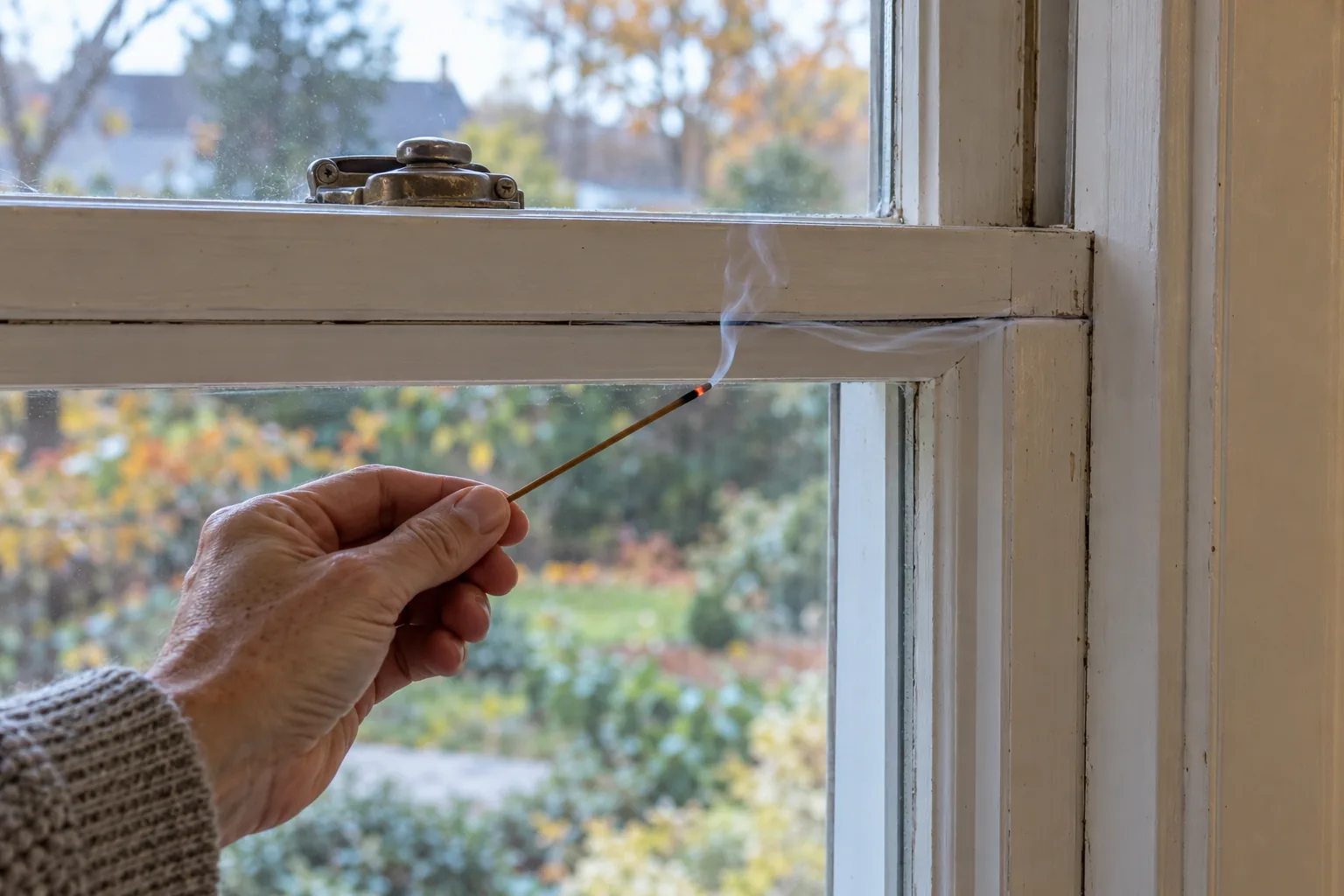
The incense test. Light an incense stick and hold it next to each seam: the sash edges, the meeting rail, the joint where the frame meets the interior trim, and the joint where the trim meets the wall. If the smoke bends one way or the other, air is moving there. Doing this on a windy day, or with bath and kitchen exhaust fans running, makes slow leaks easier to see.
Where the smoke moves tells you which of the three paths you're dealing with.
| Where the smoke moves | What's leaking | Usual fix | Rough parts cost |
|---|---|---|---|
| Sash edge or meeting rail; paper slides | Worn or compressed weatherstrip, or a lock not pulling the sashes tight | Replace weatherstrip with the maker's profile; adjust or replace the sash lock | $1.50–$11 per strip at Andersen's parts store |
| Trim-to-wall or trim-to-frame joint | Unsealed gap between the window frame and the rough opening | Caulk if the gap is ¼ inch or less; low-pressure foam or backer rod behind the trim if larger | A tube of caulk or one can of window-and-door foam |
| Nowhere, but the area still feels cold | Cold glass pulling heat off your body | Window film kit, low-e storm window, or replacement | $45–$131 per low-e storm window (EPA, 2017) |
Path one: the weatherstrip has quit
Weatherstrip is a wear part. Andersen's help center says exposure to light, moisture, temperature swings, and repeated compression wears it out over time, and tells owners to look for tears, flattened or loose sections, and missing pieces. Pull the lower sash of a 20-year-old double-hung and you'll often find the bulb seal at the bottom rail crushed flat.
The fix is cheap if you match the original profile. Andersen's parts store lists 400 Series Tilt-Wash check rail and sash stile bulb weatherstrip at $9.38 a piece, and a 200 Series bottom rail strip at $4.79. Andersen sells these by series, and the profiles aren't interchangeable, so find the product line printed on the glass spacer, the sash, or the original paperwork before you order. Generic foam weatherstripping tape can work on an old wood window, but on a vinyl or clad window a strip that's too thick can keep the sash from closing and locking.
Check the sash lock before you blame the strip. On a double-hung, the lock pulls the two sashes together at the meeting rail. If it's loose or worn, the weatherstrip never gets compressed, and the window leaks even with new seals.
Flat rule: if the paper slides out at the sash, try new weatherstrip before you price new windows. It's the cheapest repair and usually the right one.
Path two: the gap behind the trim
When the smoke moves at the trim and not at the sash, the leak is in the gap between the window frame and the wall framing. The current energy code expects that gap sealed. The air-barrier table in the IRC's energy chapter lists the space between window jambs and framing as a component that must be sealed, and older installations often have loose fiberglass or nothing there.
ENERGY STAR's guide sorts the repair by gap size. Window-and-door caulk works for cracks a quarter inch or less; choose a product rated for the surface and exposure. Larger gaps need a non-expanding foam made for windows and doors, or backer rod pressed into the gap. Two cautions apply here.
Use foam that's labeled for windows and doors. DuPont says its GREAT STUFF PRO Window & Door foam expands just enough to seal without bowing or bending the frame when applied correctly. A general-purpose expanding foam can push a jamb inward and leave you with a window that sticks. ENERGY STAR warns about the same problem with backer rod jammed in too tight.
Pulling trim is a bigger job than caulking it. ENERGY STAR rates sealing behind trim as a moderate-to-difficult DIY project. In a house built before 1978, the trim may carry lead paint. EPA's Renovation, Repair and Painting Rule generally doesn't cover homeowners working on their own homes, but any contractor you pay to disturb that paint must be RRP-certified, and EPA says window replacement in a pre-1978 home is always covered. If you're not sure what's on the trim, caulk the outside joints and leave the prying to a certified firm.
Cost estimator
Window cost estimator
A budgeting range, not a quote. Move the inputs to see what changes the number.
Estimated national cost
Typical project lands near $6,500.
If a written quote comes in above the high end, that's not automatically wrong — ask what scope is driving it.
What this assumes
- 10 replacement windows selected.
- Vinyl frame material selected.
- Standard professional installation assumed.
What moves this price
- 01Pocket vs. full-frame installation method.
- 02Glass package, grid style, trim, and flashing details.
- 03Window size, access, permit requirements, and local labor rates.
Walk into your quotes ready
This range is your anchor. Bring these to every contractor conversation so you can tell a fair quote from a padded one.
- Is this full-frame or insert (pocket) replacement, and why for my openings?
- What's the frame material and glass package (low-E, gas fill, U-factor)?
- Is removal, disposal, and interior/exterior trim work included?
- What does the warranty cover: glass, frame, and the install labor?
- A per-window price with no mention of frame condition or install type.
- 'Today only' pricing that drops dramatically when you hesitate.
- Vague glass specs, with no U-factor or low-E details in writing.
Path three: no leak, just cold glass
Sometimes the smoke goes straight up and the paper won't budge, and the spot by the window still feels drafty. ENERGY STAR explains why: the cold inside surface of an inefficient window pulls heat away from your body, so you can feel chilly in a sweater at 70°F. Air next to that cold glass also cools and sinks toward the floor, which feels like a breeze at your ankles. Neither problem gets fixed by caulk.
This is where a second layer earns its cost. A shrink-film kit is the cheap test. 3M's five-pack (2141W-6) covers five 3-by-5-foot windows, and ENERGY STAR has a project page on installing them. If the film makes the room noticeably more comfortable, a permanent layer will too.
Low-e storm windows are the permanent version. ENERGY STAR estimates about $350 a year in heating and cooling savings, roughly 10%, when you add them over single-pane clear glass, with a payback of about three years. Its estimates exclude savings from stopping air leaks in old windows, so a leaky house can do better. EPA's 2017 price survey found low-e storm windows at $45 to $131 per unit, averaging $6.16 per square foot. That works out to about $92 for a 3-by-5 window, before installation. Over clear double-pane glass, ENERGY STAR puts the gain at only about $50 a year.
When replacement actually pays
Replacement makes sense when the glass is the problem and the frames can't take a storm window, or when the frame itself is failing. ENERGY STAR's 2023 climate table shows how much the starting point matters:
| Window you're replacing | Average annual savings with ENERGY STAR windows |
|---|---|
| Single-pane clear glass | About $493 to $568, depending on climate zone |
| Double-pane clear glass | About $282 to $373, depending on climate zone |
ENERGY STAR's broader estimate is $200 to $600 a year, about 13% of energy costs, for replacing poor-performing windows. Those are national modeling averages, and your number depends on your utility rates, climate, and how many windows you have.
If you do replace, ask for the tested air leakage rating. The 2021 IRC, at Section N1102.4.3, caps windows at 0.3 cfm per square foot, tested to NFRC 400 or AAMA/WDMA/CSA 101/I.S.2/A440. The number isn't always printed on the label, so get it in writing. ENERGY STAR also notes that even the best window can be drafty if it's installed poorly, so the frame-to-wall seal matters on a new unit too. Our line-by-line quote guide covers what belongs on the bid.
Flat rule: double-pane windows with sound frames and new weatherstrip rarely justify replacement on drafts alone. Single-pane glass in rotting sashes usually does. Budget without a federal credit. The IRS says the Section 25C Energy Efficient Home Improvement Credit isn't allowed for property placed in service after December 31, 2025.
Research sources
- ENERGY STAR: Seal and Insulate with ENERGY STAR
- ENERGY STAR: Sealing Behind Window & Door Trim Project
- ENERGY STAR: Do-It-Yourself Guide to ENERGY STAR Home Sealing (PDF)
- ENERGY STAR: Applying Plastic Over Windows Project
- ENERGY STAR: Storm Windows
- ENERGY STAR: Storm Windows Version 1.0 Criteria Analysis Report, July 2017 (PDF)
- ENERGY STAR: Residential Windows, Doors & Skylights
- ENERGY STAR: Average Annual Energy Savings When Replacing Windows, October 2023 (PDF)
- ENERGY STAR: 2025 Windows Key Messages (PDF)
- EPA: Renovation, Repair and Painting Program: Contractors
- EPA: Renovation, Repair and Painting Program: Consumers
- ICC: 2021 IRC Section N1102.4.3, Fenestration Air Leakage
- ICC: 2018 IRC Chapter 11, Energy Efficiency
- Andersen: Replacing Window or Patio Door Weatherstrip
- Andersen Parts Store: 400 Series Tilt-Wash Double-Hung Weatherstrip
- Andersen Parts Store: 200 Series Tilt-Wash Weatherstrip
- DuPont: GREAT STUFF PRO Window & Door Insulating Foam Sealant
- 3M: Indoor Window Insulator Kit, Five Pack 2141W-6
- IRS: Energy Efficient Home Improvement Credit
Compare local quotes
Ready to compare real quotes from window installer pros?
Use your estimate as a budget anchor, then compare written contractor bids against it before you decide. Free request, no obligation.
Disclosure: this button opens a third-party quote-matching service. If you submit its form, its contact and privacy terms apply, and SaveBricks may earn a referral fee. It never changes the prices you're quoted, and our cost ranges are set independently — see how we estimate.
The cost guide
Get the monthly cost briefing
One useful email a month: project cost ranges, contractor red flags, and practical ways to avoid an inflated quote.
No spam. Unsubscribe any time. Read our privacy policy.
More windows guides

Window Won't Stay Up? Price the Balance Before You Price a Window
A double-hung sash that slides down on its own almost always means a failed balance, a part Andersen lists from about $21. Here's how to tell which balance system you have, what the fix costs, and when the window itself is the problem.
Read guide
Foggy Window Between the Panes? The Seal Failed, Not the Window
Haze between two panes of glass means the sealed unit is breathing outdoor air. Here's how to tell it apart from ordinary condensation, what the warranty probably owes you, and when glass-only beats a new window.
Read guide
Window Leaking When It Rains? Where the Water Shows Up Names the Fix
Water at the sill, the head, or the lower corners points to different failures. Here's how to tell clogged weeps from failed caulk from missing flashing before you buy a tube of anything.
Read guide