
Why is my thermostat screen blank?
A blank thermostat usually means power stopped somewhere between the breaker and the wall. Here's the order to check it, what's yours to touch, and when to replace the thermostat.
The short answer
A blank screen almost always means the thermostat has lost power, not that it has broken. On battery models, start with fresh batteries; on wired models, the 24-volt supply has usually been cut upstream by a tripped breaker, a loose furnace door, a full condensate pan's float switch, or a blown control-board fuse. Most of those cost nothing to check, and a new thermostat runs about $85 to $640 for a smart model at Trane's published range, so confirm the power path before you buy one.

Estimate, not a final quote
This range is for planning. Final pricing depends on an on-site inspection, materials, permits, access, and contractor scope.
Compare written bids
Ask each contractor for the same scope, warranty terms, permit handling, cleanup details, and exclusions before choosing.
Source-backed guidance
Guides use public references and practical cost modeling, then point you to official sources where rules or rebates can change.
Trane's own support guidance says it plainly: a blank thermostat display means the thermostat isn't getting power. That's useful, because it turns a vague "my thermostat died" into a narrower question. Somewhere between your breaker panel and the wall plate, 24 volts stopped arriving. Your job is to find out where, and most of the places it can stop cost nothing to check.
Battery or wired decides where you start
Pull the thermostat body straight off its wall plate and look at the back. If there's a battery compartment, start there. Honeywell's blank-display instructions for models like the TH4210D and RTH6360 begin with replacing the batteries on any battery-powered unit, and the TH4210D ships with two AA alkaline cells.
If your thermostat is hardwired with a C (common) wire, Honeywell suggests a clever test: put batteries in anyway, if it takes them. A wired thermostat that wakes up on batteries is working fine. It's the power feeding it that's missing, and the next places to look are your breakers, the furnace power switch, and the furnace door switch.
If the thermostat stays dark on fresh batteries, and the system is getting power, the thermostat itself may be the failed part.
| Check | What the manufacturer says | Number to know | Cost |
|---|---|---|---|
| Batteries | Replace on any battery model first (Honeywell, Trane) | 2 AA alkaline on a TH4210D | Batteries only |
| Reset after a power spike | Remove batteries and pull the unit off its plate (Trane) | 2 minutes out | $0 |
| Reboot at the breaker | Power-cycle the indoor unit's breaker if it's on (Trane) | 20–30 seconds off, then several minutes to reboot | $0 |
| Breaker found tripped | Consult an HVAC pro rather than resetting (Trane) | One trip is a symptom | Service call |
| Float switch tripped | Cuts the thermostat circuit when the pan fills (RectorSeal) | Rated 24 VAC, 1.25 A | $0 to clear yourself, or a service call |
| New thermostat | Pro needed for wiring changes and high-end models (Trane) | $85–$640 for a smart model | Device plus labor |
Reboot, but know the difference between "off" and "tripped"
Trane's support steps for a blank, white, or black screen start with making sure the system isn't mid-cycle. Listen for it, and if it's running, wait for the cycle to finish. Then find the breaker for the indoor furnace or air handler. That's usually the one feeding the thermostat, not the outdoor condenser's breaker. Switch it off for 20 to 30 seconds, switch it back on, and give the thermostat several minutes to come back.
That's a reboot of a breaker that was already on. A breaker you find already tripped is a different story. Trane's thermostat troubleshooting page says to consult an HVAC professional in that case, because whatever tripped it may damage the system when power comes back. Trane's indoor-unit owner's guide allows resetting a tripped breaker or replacing a fuse once, then says to call for service if it happens again.
Flat rule: if the breaker trips a second time, stop resetting it. A repeat trip is a short or a failing motor talking, and every reset is another chance to burn something out.
If a voltage spike or static discharge scrambled the display, Trane's reset for its programmable models is simple: take the thermostat off the wall plate, remove the batteries for 2 minutes, then put everything back.
The furnace door switch
Many furnaces and air handlers have a push-button safety switch behind the blower compartment door. When the door comes off, the switch opens and cuts power to the whole unit, thermostat included. That's why Honeywell lists the "furnace door kill switch" alongside the breaker in its blank-display steps.
If someone changed the filter recently, check that the door panel is fully seated and latched. A panel hanging a quarter inch off its tabs is enough. Never tape down or defeat the switch to run the unit with the door off. It exists so the blower and live wiring aren't exposed while someone's hand is inside.
A full drain pan can shut the thermostat off on purpose
If the thermostat went blank on a day the AC was running hard, and your air handler sits in an attic or closet, look at the condensate pan. Many installs use a float switch like the RectorSeal Safe-T-Switch SS2, which mounts on the pan's auxiliary drain outlet. RectorSeal's product literature rates its switches at 24 VAC and 1.25 amps for use in Class 2 thermostat circuits only, and wires them in line with the red or yellow conductor. When water lifts the float, that circuit opens.
Depending on whether it interrupts the red wire or the yellow one, the result is either a blank thermostat or a thermostat that looks normal while nothing runs. Trane describes the same behavior from its overflow switches: the compressor, condenser fan, and supply fan all shut down.
The code expects this. The IRC's condensate rules, in Section M1411.3.1, allow a water-level detection device in place of a secondary drain line, and the ICC's commentary describes these alternatives as providing automatic shutdown of the appliance when the drain stops up. Never bypass a float switch to get the screen back. Clear the drain and the switch resets itself. Our AC leaking water guide walks through which drain clogs you can clear and which need a technician.
Cost estimator
HVAC cost estimator
A budgeting range, not a quote. Move the inputs to see what changes the number.
Estimated national cost
Typical project lands near $8,250.
If a written quote comes in above the high end, that's not automatically wrong — ask what scope is driving it.
What this assumes
- Standard central HVAC replacement scope.
- 1,500 sq ft home size selected.
- No major duct, electrical, or structural repairs included.
What moves this price
- 01Equipment tier, SEER2 rating, and brand.
- 02Ductwork condition and attic or crawlspace access.
- 03Permit requirements, refrigerant changes, and local labor rates.
Walk into your quotes ready
This range is your anchor. Bring these to every contractor conversation so you can tell a fair quote from a padded one.
- What SEER2 rating and tonnage are you quoting, and why that size for my home?
- Is a full load calculation (Manual J) included, or are you sizing by rule of thumb?
- Does the price include new line sets, a permit, and haul-away of the old unit?
- What's the labor warranty, and is it separate from the manufacturer's parts warranty?
- A quote given over the phone without seeing your ductwork or home.
- Pressure to decide today or 'lose' a discount.
- An oversized system pitched as 'more powerful'. Bigger isn't better for comfort.
The fuse on the control board
Inside the furnace or air handler, the 24-volt transformer feeds the control board, and many boards carry a small automotive-style fuse on that low-voltage side. A rubbed-through thermostat wire, a pinched condensate pump lead, or a shorted contactor coil outside can blow it in an instant. The thermostat goes dark, and so does everything else on that circuit.
This is where you stop. Replacing that fuse means opening the burner or blower compartment of a furnace with line voltage present, and a fuse that blew once will often blow again until someone finds the short. A technician checks for 24 volts across R and C at the board, traces the shorted wire, and only then replaces the fuse with the same rating. A bigger fuse doesn't fix anything. It just moves the failure to the transformer.
Smart thermostats add one more version of this. Google's Nest support says heat-only, cool-only, zoned, and heat pump systems need a C wire or a Nest Power Connector. A Nest showing gray, undetected wires on its Wiring info screen isn't seeing voltage on those terminals. If every wire is gray, Google points to power being off at the breaker or fuse box.
When the thermostat is the dead part
If fresh batteries don't wake it, and a technician confirms 24 volts at the wall plate, the thermostat has failed. Trane considers a thermostat old at 10 years, and lists lost settings, inaccurate readings, and short cycling among the other signs of a bad one. Our short-cycling guide covers how a misplaced or misconfigured thermostat ends heat calls early.
Flat rule: past 10 years, with power confirmed at the plate, replace it rather than paying someone to diagnose it further. Trane prices its smart thermostats at $85 to $640. It notes that installing one yourself carries no labor cost, but higher-end models and anything requiring wiring changes need a professional. That includes adding a C wire.
If you're replacing anyway, EPA says an ENERGY STAR certified smart thermostat saves the average user more than 8% of heating and cooling energy, or about $50 a year. Your savings depend on your climate, your schedule, and how much setback you were already doing by hand.
Before you call anyone, note three things: whether the thermostat wakes on batteries, whether you found a breaker tripped or a door panel loose, and whether there's water in the drain pan. A technician who hears "wakes on batteries, pan is full" brings a wet-vac. One who hears "wakes on batteries, pan is dry, fuse looks dark" brings a meter and goes looking for a short.
Research sources
- Trane: Thermostat Not Working, Causes and Solutions
- Trane Home Support: If Your Thermostat Is Blank, Has a White Screen, or a Black Screen
- Trane: Top 7 Signs of a Bad Thermostat
- Trane: Thermostat Installation Cost
- Trane: Troubleshooting the HVAC Air Handler Overflow Switch
- Trane: Owner's Guide, Indoor Units (32-5064)
- Honeywell Home: How Do I Fix a Blank Display on My RTH6360 Thermostat?
- Honeywell Home: How Do I Fix a Blank Display on My TH4210D, TH4110D, TH4110B Thermostat?
- Honeywell: TH4210D Installation Guide
- Google Nest Help: No Power Alerts and C Wire Requirements
- RectorSeal: Safe-T-Switch SS2
- RectorSeal: Safe-T-Switch Product Overview
- ICC: 2018 International Plumbing Code Essentials, Condensate Disposal
- ENERGY STAR: First-Ever Smart Thermostat Specification
Compare local quotes
Ready to compare real quotes from HVAC contractor pros?
Use your estimate as a budget anchor, then compare written contractor bids against it before you decide. Free request, no obligation.
Disclosure: this button opens a third-party quote-matching service. If you submit its form, its contact and privacy terms apply, and SaveBricks may earn a referral fee. It never changes the prices you're quoted, and our cost ranges are set independently — see how we estimate.
The cost guide
Get the monthly cost briefing
One useful email a month: project cost ranges, contractor red flags, and practical ways to avoid an inflated quote.
No spam. Unsubscribe any time. Read our privacy policy.
More hvac guides

Furnace Making a Loud Noise? Note When in the Cycle It Happens
A furnace starts in a fixed order, and each stage has its own noisy part. Here's how to match the sound to the stage, what each repair costs, and which one means shut it off.
Read guide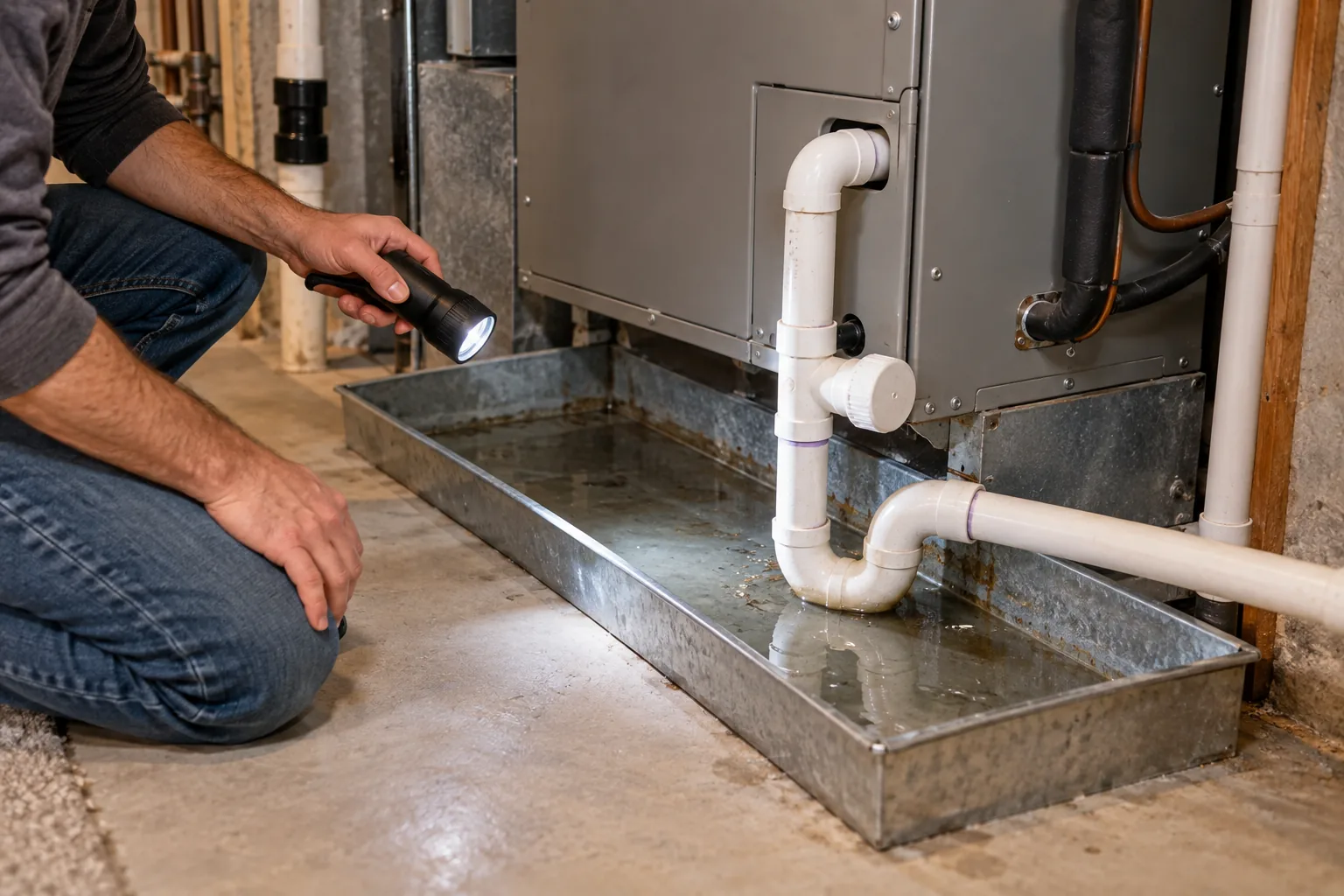
AC Leaking Water Inside? Find Where the Water Stops Moving
Most indoor AC leaks come from a clogged condensate drain, not a broken system. Here's how to tell a drain clog from a cracked pan or an iced coil, and what each costs.
Read guide
House Humid With the AC Running? Read the Hygrometer Before You Buy Anything
A cool, clammy house usually points to the fan setting, an oversized AC, or air leaking in. Here's how to tell which one you have and what each fix really costs.
Read guide